The People, Places, Events, Customs and More from the Victorian Era. Please Scroll Down to Explore Links to Other Sites of Historical Interest:

Friday, 15 June 2012

“She Seemed to Realize…the Intense Loneliness of her Lot; and, When I Put My Arm Round Her She Clung to Me With Such Sobs That I Could Hardly Help Crying Too. “ Or: More Working Children of the 19th Century:

By far the most popular post I have ever written on this blog is this article, entitled ‘Working Children of the 19th Century’ from November 2010. It has been looked at well over a thousand times more than its closest rival, and so, I thought perhaps I would re-visit the subject of Victorian working children whilst I was reading an article about them in an old magazine.

The Strand Magazine, from which I have taken the article, was a fairly late-comer to the world of Victorian publication, with its first issue being printed in January 1891. As a bit of a collector of Victorian papers and magazines, I must admit that The Strand is an excellent little eye on the world of the late Victorian period, as it combines fiction with factual articles. Many publications from the period can be, I find, a little difficult to read if they are purely news-based. Interesting, of course, but if you don’t have a full grasp on a story, it can be a little dull reading a small portion of it, so, in many ways, since The Strand contains whole articles on various social aspects of the Victorian period, it gives a far broader view on the topics it covers – if not quite as detailed.


The magazine’s biggest claim to fame is that it was the home of the Sherlock Holmes serializations, but it can boast many other famous contributors, such as Agatha Christie, Arthur Morrison, Rudyard Kipling, H.G Wells, and also a lady we have seen a lot of recently on this particular blog; Queen Victoria, who had a sketch published in the magazine.

Before I move onto the article, I’d like to say how much I like the front cover of The Strand, which is a lovely sketch of – predictably – The Strand, in London, looking toward Mary Le Strand. This was designed by the artist George Charles Haitè. The title of the magazine is suspended from telegraph wires, zig-zagging above the thoroughfare.

Enough of the publication, and onto the article:

Child Workers in London

This article does not profess to be an exhaustive account of all the employments in which London children are engaged. The limits of a magazine article do not allow of a full and detailed account of this very comprehensive subject. No individual or body of individuals has any precise information about the hundreds of children engaged as ballet dancers, acrobats, models, and street vendors, to give only a few names in the vast army of child workers.

Nothing can be harder and drearier than the lot of little servants, employed in many cases in lodging-houses. They are on their feet all day long, at everyone’s beck and call, and never expected to be tired or sit down properly for a meal; the food is of the poorest quality; they have heavy weights to drag up and down stairs in the shape of coal-scuttles, and the inevitable strapping baby; their sleeping apartment is as often as not a disgraceful hole, and such requisites to health as are generally considered necessary in the shape of exercise, fresh air, and baths are unknown quantities.

There is a strong prejudice against the “factory girl” in many quarters, and “service” is indiscriminately extolled as far more suitable for a respectable girl of the lower classes. It would be, if there were any chance of the docker’s child or the coster’s child obtaining a decent situation; but, as a matter of fact, the life of the much-pitied match-worker is infinitely easier than that of these little drudges. At eight o’clock the factory girl is at any rate free to get out into the open air for a couple of hours, or to sit down and rest. The little “general” is never free. One child told me – she was the daughter of a docker who was the happy owner of eleven children, and was herself an under-fed, anaemic-looking creature – that she got up at six every morning to
“make the gen’l’m’s breakfast – it was a lodging house; after that there’s the steps, ‘ouse work, peeling potatoes, and sich like, till dinner. I never sits down till we ‘ave a cup o’ tea after the lodgers ‘ave ‘ad their suppers. But the missis – oh, she is a nice, kind laidy, and she works with me, she do.”
“I suppose,” I said “you are able to get out on Sunday’s?”
“Once a month I goes ‘ome, but I nusses the baby on Sunday, as we ain’t so busy. ‘E’s such a beauty; I’ll ask missis if I can bring ‘im down; ‘e can’t walk by ‘isself.”

And off darted the little maid to the top of the house as if she were not on her thin legs from morn to night, returning presently with a huge and well-fed baby, about three times as fat as herself. I am bound to say this girl seemed contented, and, as lodging-house landladies go, her mistress seemed a fairly good one; but what a life of exhaustive and unremitting labour, even under these conditions, for a child of thirteen; and what a life of horrors if her mistress had been a brutal or cruel woman! The usual payment is 2s. 6d. a week, but I found in a number of cases the girls only receive 1s., or even 9d., their mistresses deducting the rest of their salary for the payment of the clothes which they have been compelled to buy for them on arrival, the little servant being too often in possession of a hat with feathers, a fur boa, and a brass locket, which, with the garments she stands up in, form her entire outfit. A pathetic little story was told me about a bright-faced girl I happened to come across.

“I got to know of her,” said my informant, a lady who does much quiet good, and whose name is unknown to newspaper readers, “last year. A friend of mine whose Sunday-school she attended in Deptford asked me to look her up. I happened quite by chance to call in at the coffee tavern where she was to act as a servant, a few moments after she had arrived, and I was told I might go up to the ‘bedroom.’ Well, I wont go into particulars about that ‘bedroom.’ It was nearly dark, and I found the poor little soul sitting on the only available piece of furniture in the room – her own little tin hat-box. I shall not easily forget that dazed, bewildered look with which she met me. It was all so strange; everyone had been too busy to attend to her, and, though she had come from a wretched home, where the playful father had been in the habit of making her a ratget for his boot shying, still there had been familiar faces round her. She seemed to realize in the sort of way young people do not, as a rule, the intense loneliness of her lot; and, when I put my arm round her she clung to me with such sobs that I could hardly help crying too. “

Fortunately, sensitive child-servants are tolerably rare, and I am bound to say I failed to find any answering to this description. They were generally what one might describe as decidedly “independent!” one girl – she was barely fifteen – told me she had been in six places.
“Are you so fond of change?” I asked.
“’Tain’t that so much,” returned the young lady; “but I cant put up with ‘cheek,’ and some o’ my missises do go on awful. ‘I says: ‘Ave yer jaw, and ‘ave done with it.’”

This certainly was rather an awful specimen; but she could not have been very bad, as her present mistress – who, I presume, has not up to the present “checked” her – assured me that the girl handed over her 2s. 6d. a week regularly to her mother. This seems to be the usual practice with the girls. Their mothers buy their clothes, and give them a shilling on Bank Holidays and a few pence every week to spend on themselves. A large proportion of these little drudges marry dockers and labourers generally, and, as their training has not been exactly of the kind to render them neat, thrifty housewives, it is perhaps not surprising that their cuisine and domestic arrangements altogether leave much to be desired.

There is perhaps no form of entertainment more popular amongst a large class of playgoers than that afforded by the clever acrobat, of whose private life the public has only the vaguest knowledge. The general impression, derived from sensational stories in newspapers and romances, is that the profession of the gymnast is a disreputable one, involving a constant danger of life and limb; and that young acrobats can only be made proficient in the art by the exercise of severity and cruelty on the part of trainers.

The actual facts are that the owners, or, as they are called, “fathers,” of “troupes” are, in a number of cases, respectable house-holders, who, when not travelling over Europe and America, occupy little villas in the neighbourhood of Brixton and Clapham; that the danger is immensely exaggerated, particularly in the case of boys, who are always caught when they fall; and that the training and discipline need not be any severer than that employed by a schoolmaster to enforce authority.
 “Of course,” said a trainer of long experience to me, “I sometimes get an idle boy, just as a schoolmaster gets an idle pupil, and I have my own methods of making him work. But I would lay a heavy wager that even a lazy lad sheds less tears in his training with me than a dull schoolboy at a public school. I have never met with a single boy who didn’t delight in his dexterity and muscle; and you will find acrobats as a whole enjoy a higher average of health than any other class.”

There are no “Schools of Gymnastics” for training acrobats in London, the regular method being that the head of each troupe – which usually consists of five or six persons, including one or more members of the family, the acrobatic instinct being strongly hereditary – trains and exhibits his own little company. The earlier a boy begins, of course, the better; and, as a general rule, the training commences at seven or eight years old. Many of the children are taken from the very lowest dregs of humanity, and are bound over by their parents to the owner of a troupe for a certain number of years. The “father” undertakes to teach, feed and clothe the boy, whilst the parents agree not to claim him for a stipulated number of years. A boy is rarely of any good for the first couple of years, and it takes from five to six years to turn out a finished gymnast.
“Is it true,” I asked of the head of the celebrated “Yokohama Troupe,” “that the bones of the boy are broken whilst young?”
Mr. Edwin Bale, who is himself a fine specimen of the healthy trapezist, smiled pityingly at my question, and asked me to come and watch his troupe practice. All gymnasts practice regularly for two hours or more every day. The “Yokohama Troupe” includes three boys, all well-fed looking and healthy, one of them being Edwin, the fifteen-year-old son of Mr. Bale, a strikingly handsome and finely-developed boy, who has been in the profession since he was two.

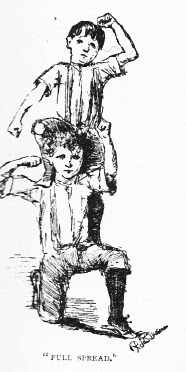
The first exercise that young boys learn is “shoulder and legs,” which is practiced assiduously till performed with ease and rapidity. After this comes “splits.” This exercise looks as if it ought to be not only uncomfortable but painful; but a strong proof that it is neither was afforded me involuntarily by one of the little boys. He did it repeatedly for his own benefit when off duty! After this the boy learns “flip flap,” “full spread,” and a number of intricate gymnastics with which the public is familiar. In all these performances boys are very much in request, partly because they are more popular with the public, and partly because in a variety of these gymnastic exhibitions men are disqualified from taking any part in them owing to their weight. In the figure technically known as “full spread” (shown in illustration) it is essential that the topmost boy shall be slightly made and light in weight; but even under these conditions the strain on the principal “supporter” is enormous. As regards danger, so far as I have been able to learn from a good deal of testimony on the point, there is very little of any kind. The only really dangerous gymnastic turn is the “somersault,” which may have serious results, unless done with dexterity and delicacy. There is no doubt that exercise of this kind is beneficial to the boys’ health. Several boys in excellent condition, with well-developed muscles and chests assured me they were often in the “’orspital” before they became acrobats.
Their improved physique is possibly in a great measure due to the capital feeding they get, it being obviously to the advantage of the “father” to have a robust, rosy-faced company. Master Harris, of the “Yokohama Troupe,” informed me that he generally has meat twice a day, a bath every evening (gymnasts are compelled by the nature of their work to keep their skins in good condition by frequent bathing), that Mrs. Bale was as kind to him as his own mother, and that he thought performing “jolly.” He further informed me that he got three shillings a week for pocket money, which was put inton the bank for him.

Another boy in the same troupe told me he had over £9 in the bank. Of course, all companies are not so well looked after as the boys in Mr. Bale’s troupe; but I have failed to discover a single case where the boys seemed ill-used. Where the troupe travelled about Europe, the lads were exceptionally intelligent, and several of them could talk fair French of German. A really well-equipped acrobat is nearly always sure of work, and can often obtain as much as £30 a week, the usual payment being from £20 to £25 a week. As a rule, the boys remain with the master who has given them their training, and who finds it worthwhile, when they are grown up, to pay them a good salary. A troupe gets as much as £70 or £80 a day when hired out for fetes or public entertainments. There is one point which will possibly interest the temperance folk, and which I must not forget. The boys have constantly before them moderation in the persons of their elders.

“Directly an acrobat takes to drinking,” said Mr. Bale, impressively, “he is done for. I rarely take a glass of wine. I can’t afford to have my nerves shaky.” Altogether there are worse methods of earning a livelihood than those of the acrobat; and a propos of this point, an instructive little story was told me which sentimental, fussy people would do well to note. There was a certain little lad belonging to a troupe the owner of which had rescued him from the gutter principally out of charity. The boy was slight and delicate-looking, but good feeding and exercise improved him wonderfully, and he was becoming quite a decent specimen of humanity when some silly people cried out about the cruelty of the late hours, and so on, and insisted that he should be at school all day. The lad, who was well fed, washed, and clothed, was handed back to the care of his parents. He now certainly attends school during the day, but he is running about the gutter every evening, barefooted, selling matches till midnight!

On the subject of ballet children there is also a great deal of wasted sentiment. All sorts and descriptions of children are employed in theatres, from the respectable tradesman’s child to the coster’s child in Drury Lane; but the larger proportion are certainly of the very poorest class, and it must be remembered that these children would not be tucked up safely in their little beds, if they were not earning a few badly-wanted shillings; they would be running about he London streets.

Mr. D’Auban – who has turned out a number of our best dancers, such as Sylvia Grey, Letty Lind, and others, - was kind enough to call a rehearsal of his children, who are now performing at the Lyric, Prince of Wales, Drury Lane, and other theatres, so that I was enabled to see a very representative gathering of these useful little breadwinners. Whatever else may be urged against the employment of children in theatres, there is not the least doubt that dancing is a pure pleasure to them. Out of all the little girls I questioned, not a single one would admit that she ever felt “tired.” A good many of the children belong to theatrical families, and have been on the stage since they were babies; they were distinguished by a calmness and self-possession which the other little ones lacked; but in the matter of dancing there was very little difference, and it was difficult to believe that a large proportion of the children now playing in “La Cigale,” knew nothing about dancing six months ago. Mr. D’Auban has no apprentices, no agreements, and no charges, and he says he can make any child of fair intelligence a good dancer in six months.

The classes begin in May, and, as soon as it is known that Mr. D’Auban wants children, he is besieged by parents with little maids of all sizes. The School Board only allows them to attend two days a week; but Mr. D’Auban says: “Everything I teach them once is practiced at home and brought back perfect to me.” The children wear their ordinary dress, and practicing shoes of any kind are allowed. First the positions are mastered, then chasses, pirouettes, and all the rest of the rhythmic and delicate movements of which ballets consist.

Many of these graceful little dancers are the real bread winners of the family. Little Minnie Burley, whose charming dance in “The Rose and the Ring” will be remembered, though only eleven years old, has for more than a year practically supported herself and her mother by her earnings. The mother suffers from an incurable spinal complaint, and, beyond a little help which she gets from another daughter who is in service, has nothing to live upon but the little one’s earnings. During the double performance of the “Rose and the Ring,” Minnie earned £1 5s. a week; now she is earning as a Maypole dancer in “Maid Marian” 12s. a week: but her engagement will soon end, and the poor little maiden, who has the sense and foresight of a woman of thirty, is getting rather anxious.

She is a serious-faced, dark-eyed child, very sensible, very self-possessed, and passionately fond of dancing. Her mother is devoted to her, and keeps her exquisitely neat. I asked her whether she did not feel a little nervous about the child coming home alone every night from the Strand.
“No,” said Mrs. Burley, “you see, she comes by ‘bus, and she knows how to take care of herself – she knows she is not to let anyone talk to her.”

Minnie is a type of dozens of other hard working, modest little girls who are supporting themselves, and very often their families, by dancing. As a rule, the mothers fetch the children, or make arrangements for several to come home together. Many of them, whose husbands have been out of work, or who are widows, or deserted, have assured me they could not possibly have got through the winter without the children’s earnings, whilst the children themselves are immensely proud of “helping” mother. The pride they take in their parts is also very amusing. One small girl ran after me the whole length of a street. She reached me breathless, saying, “Don’t forget I’m principal butterfly.” Another small mite gave me a most crushing reply. She made some allusion to her mother, and I said innocently, “I suppose your mother is a dresser?” She looked daggers at me, and said indignantly, “My mother’s a lady wots in the ballet.”

The wages of the children range from 6s. to 16s. a week, and, as their engagements often last for four months at a time, it will be seen that their money is a valuable, and in may instances an essential, addition to the mother’s purse.
Child models, being required almost exclusively in the daytime, are, thanks to the vigilance of the School Board authorities, becoming more and more scarce. The larger number of them comes from “model families,” the mother having sat herself, and having from an early age accustomed their children to “sitting.” The children of these families have no difficulty in obtaining regular work; they get a reputation in the painting world, and one artist recommends them to another. In the neighbourhood of Fitzroy Square, Holland Park, and St. John’s Wood these families abound, and are mostly in respectable circumstances. A pretty little girl, whose mother is a well-known model, and who has herself figured in several of Millais’ pictures, told me with condescension that she had so many engagements she didn’t know which artist to go to first.

Mary M–––, whose face is familiar to admirers of Miss Kate Greenaway’s pictures, is, except for a couple of months in the summer, never out of work. She is a beautiful child of fourteen, the daughter of a cab-driver, who is not always in regular employment; and, as Mary has a tribe of little brothers, her earnings are of the utmost usefulness. For several months she has been sitting to three artists, and making the very respectable sum of £1. 10s. a week.
In her spare moments Mary takes music lessons, and her great ambition is to become an illustrator in black and white. All her earnings are cheerfully handed over to her mother, who is careful of her little daughter’s welfare as can be.
“I don’t sit as a nude model,” Mary said, “but only for my head, and mother doesn’t let me go into any studio.”

As a matter of fact, children are not used as nude models to any great extent; they do not sit still enough, and their limbs are too thin and unformed to be of much use. Besides the regular professional models, who get 5s. a day, and are pretty sure of engagements, except in the summer, there is a fairly large class of street children who call at the different artists’ studios, and are taken on occasionally.
“I get any number,” said a well-known artist. “They come down to me, and are kind enough to suggest ideas. One small girl said to me the other day. ‘could you do me in a blue dress, sir; mother says it would go well with my golden ‘air.’”

Many artists prefer these children to the regular model, who get a stereotyped expression and artificial poses from long habit. Mr. T.B. Kennington, whose pictures of poor London children are familiar to the public, told me that he always actually paints from the class of children that he depicts on his canvas. The boy whop figured in that painful and powerful picture of his, “Widowed and Fatherless,” is a real little London waif.

"Widowed and Fatherless" T.B. Kennington, 1888
 His mother is said to have been pitched out of window by her husband, and the boy, whose sad face arrests the attention of the most careless observer, lives with his grandmother, who does washing.
“Do you make the children ‘put on’ this sad expression?” I asked Mr. Kennington.
“No, indeed; my great difficulty is to make them smile, except momentarily. Haven’t you ever noticed how melancholy children look in repose?”
This may be true about children who are constantly half-starved and ill-treated, but surely it is not true of children in general, or even of the majority of children of the lower classes, who contrive to wear an air of marvelous brightness, in spite of cold, hunger, and even blows. “Sitting” does not seem to be an occupation that commends itself to children, who naturally dislike keeping perfectly still in one position. Nearly all the little models prefer ladies, who keep them quiet by telling them stories, and bestowing sweets and cakes on them; whereas male painters have less persuasive methods of making them do what they want. These latter, however, make many attempts to reform the manners and morals of their small models, many of whom, they say, evince an appalling amount of depravity.

Mr. F.W. Lawson, who painted some veritable little slum waifs, in his series of pictures called “Children of the Great Cities,” told a good little story of one of his attempts in this direction. His model was a small, bright-faced, black-eyed street boy.
“Well, Fred, what have you been doing today?” asks Mr. Lawson.
“Playing on Battersea Bridge, sir, and chucking stones at mad old Jimmy,” was the reply of the urchin, who then proceeded with much gusto to describe the details of this sport.
Mr. Lawson, on learning that mad old Jimmy added blindness to his other infirmities, spoke strongly about the cruelty and cowardice of such an entertainment; and ended up by telling a story of a heroic deed by a blind man.
“When I looked up,” said Mr. Lawson, “I saw the boys eyes were full of tears, and I thought to improve the occasion by asking, ‘And now, Freddy, what will you do if you meet mad old Jimmy again?’ The little scamp looked up with a wink and said, chuckling, ‘Chuck stones at ‘im, sir.’”

Professional models, especially those who have sat to eminent artists, have an exaggerated idea of their comeliness, and they will draw your attention to their good points with much frankness.
“I’ve got beautiful ‘air.” Said one little girl, modestly pointing to her curly, chestnut locks; whilst a small boy, usually called the “Saint,” from having figured in several religious pictures, requested me to observe his “fine froat,” as if he had been a prize beast.

In London, owing to the numerous restrictions imposed on employers, there are only a comparatively small number of children working in factories. Girls of thirteen and upward are employed in confectionary, collar, jam, and match and other factories where skilled labour is not required, whilst small boys are principally found at rope works, foundries, and paper-mills, where their chief business is to attend to the machinery. It is almost impossible to mistake the factory-girl, and even at a glance one notes certain characteristics which distinguish her from her sister workers. Contrast her, for instance, with the theatre child out of Drury Lane. The little actress may be as poor as the Mile End factory girl, but in nine cases out of ten she will be neatly clad, with spotless petticoats and well-made boots and stockings. If you watch her, you will notice she walks gracefully, and instinctively assumes, whenever she can, a picturesque and taking attitude.
The little factory girl is decently enough attired so far as her frock is concerned, but she, or her mother, cares nothing about her boots, which are invariably cheap and untidy, whilst any superfluous coin is devoted to the adornment of her hat, an article of great importance amongst factory-girls – young as well as old. But a still more characteristic feature, which, so far as I know, is peculiar to factory-girls, is their curious method of walking, which is carefully cultivated and imitated by the young ones. It is a sort of side “swing” of the skirts, and has one of the ugliest effects that can be produced, especially when executed by half a dozen young ladies walking abreast on the pavement.

At Messrs. Allen’s chocolate and sweet factories, in Mile End, some two hundred women and girls are employed. Referring to the strike, I asked a highly respectable, intelligent-looking girl, why she joined it:
“Well, I don’t hardly know,” was the candid reply. “It was all done in a rush, and the other girls asked me to come out.”
This girl was earning, by the bye, 17s. a week.

The quite young girls are principally employed in packing chocolate into boxes, covering it with silver paper, which operation they perform with great dexterity, labeling, and other easy work of this nature. The rooms are large and well ventilated, and each department is under the care of a forewoman, who not only keeps a sharp look-out on the work, but exercises what control she can have over behaviour and conversation.

The discipline did not strike me as particularly severe, considering that the girls left their work en masse, as soon as one of their number had announced, referring to the artist, “She’s takin’ Em’ly’s likeness.”
The hours, from 8 to 7, are certainly too long for girls in delicate health; but the work itself is light, and a capital dining-room is provided on the premises, where the girls can cook their dinners and make themselves tea. Nor are the prospects at all bad. Here is Alice C –––, a girl of fourteen, the daughter of a flower carman, not always in work. She is a packer, and gets 6s. a week, which she hands over to her mother. She says she likes doing things with her hands, and would not like to be in service, as then she wouldn’t have her Sundays to herself. If she stays on at Messrs. Allen’s, her wages will be steadily raised to 18s. a week; and, if she ultimately becomes a piece-worker, she may make as much as 24s. or 25s. a week.
Considering that a good many educated women are teaching in High Schools for salaries of £65 per annum, this is surely not bad.

Of course all factories are not as well managed as these chocolate works, and where the hardship comes in is where hands are turned off at certain periods of the year, or when the work itself, like match-making, is injurious to health.

Still more unfortunate is the lot of some of the little girl workers who assist their mothers at home in tailoring, button-holing, and dolls-clothes making. The united work of mother and child yields only a wretched pittance, and, carried on as it is in a room where sleeping, eating, and living goes on, is, of all forms of labour, the saddest and most unhealthy. Meals consist of bread and tea, and work is prolonged till midnight by the light of one candle, with the consequence that the children are prematurely aged and diseased. This is the most painful kind of child-labour that I have come across, and would be unbearable, if it were not ennobled by the touching affection that almost invariably exists between the worn-out mother and her old-woman-wise little daughter.

The lot of the child-vender in the streets would be almost as hard, if it were not, at any rate, healthier. Terrible as are the extremes of weather to which the little flower-girl or newspaper boy is exposed, the life is in the open air, and a hundred times preferable, even if it results in death from exposure, to existence in a foul-smelling garret where consumption works its deadly way slowly. Children find an endless variety of ways of earning a living in the streets. There are the boot-black boys, who form a useful portion of the community; newspaper boys, of whom the better sort are useful little capitalists, with an immense fund of intelligence and commercial instinct; “job chaps,” who hang about railway stations on the chance of earning a few pence in carrying bags; flower-girls, match-girls, crossing sweepers, who can make a fair living, if they are industrious; and lastly, although this enumeration by no means exhausts the list – street prodigies, such as pavement painters and musicians. All Londoners must be familiar with the figure of little Master Sorine, who sits perched upon a high stool diligently painting away at a marine-scape in highly coloured chalks.

This clever little artist of eleven is the principal support of his parents, who do a little in the waste-paper line when there is anything to be done. As a rule, Master Sorine is finishing his marine picture or landscape when I pass by, so that I have not had an opportunity of judging of his real ability; but his mother, who keeps guard over him, assures me that he can draw “anything he has seen” – an assertion which I shall one day test. The little fellow is kept warm by a pan of hot charcoal under his seat, which would seem to suggest rather an unequal distribution of heat. However, he seems to think it is “all right.”

His artistic efforts are so much appreciated by the multitude that on a “good day” he earns no less than 9s. or 10s., which mounts up to a respectable income, as he “draws in public” three days a week. Master Sorine, however, is exceptionally fortunate, and indeed, there is something particularly taking about his little stool, and his little cap, and the business-like air with which he pursues his art studies. Nothing can be said in praise of such “loafing” forms of earning a livelihood as flower-selling, when the unhappy little vender has nothing but a few dead flowers to cover her begging; or of “sweeping,” when the “crossing” of the young gentleman of the broom is often dirtier than the surrounding country.

Now and again one comes across industrious, prosperous sweepers, who evince a remarkable amount of acuteness and intelligence. It may have been chance, but each of the crossing sweepers I questioned were “unattached,” disdained anything in the way of families, and declined to name their residence on the ground that they were “jes’ thinkin’ o’ movin’.” This is a very precarious method of earning a livelihood, and is generally supplemented by running errands and hopping in summer.
In a wealthy neighbourhood, frequented by several members of Parliament, who were regular customers, a very diligent young sweeper told me he made on average in winter 2s. 6d. a week; but he added contemptuously:
“Business ain’t what it used to be. Neighbour’ood’s goin’ down, depend on it. I’m thinkin’ of turnin’ it up.”
This young gentleman supplemented his income by successful racing speculations, obtaining his information about “tips” from his good-natured clients. It seems sad to think how much good material is lost in these smart street boys, whose ability and intelligence could surely be turned to better account. The most satisfactory point – and one which no unprejudiced person can fail to recognize – in connection with the subject of child-labour is that healthy children do not feel it a hardship to work, and that, therefore, considering, in addition, how materially their earnings add to their own comfort, all legislation in the direction of restriction and prohibition ought to be very carefully considered.

I must express my best thanks to Mr. Redgrave, of the Home Office, for his help in obtaining entrance to factories, and to Mr. Didcott, the well-known theatrical agent, for his kind services in the matter of acrobats.
             - Strand Magazine, 1891

The Strand Magazine ran for almost sixty years, before ceasing to be in 1950, however, it was brought back into publication in 1998, and has a website; strandmag.com

Anyone interested in articles of this ilk, or lesser-known works of fiction by popular authors of the past would be well-advised to look on eBay, or search antique book shops for bound editions of this magazine, as they really do contain some interesting work.

Returning to the subject of Victorian children before I close, to offer a little contrast I may return to The Strand for another article on Victorian children in the near future, but on a somewhat brighter note.

Finally, in closing, a picture of the modern-day Strand!


Thursday, 31 May 2012

“Victoria, by Grace of God, Queen for Sixty Years! The Occasion of our Day of Celebration is Without Parallel or Precedent.” Or: The Diamond Jubilee of Queen Victoria

It wont, I’m sure, have escaped anyone’s attention that 2012 marks the sixtieth year of the reign of Queen Elizabeth II, our second-longest serving monarch (for now). Plenty of newspapers have included supplements over the last few weeks to celebrate the Diamond Jubilee, and I have perused – and even kept – a couple of them myself, but I’m also lucky enough to own a copy of the Illustrated London News Diamond Jubilee Number for Queen Victoria’s sixtieth year as monarch, a hundred and fifteen years ago. 

Amazingly, very little has changed in the approach by the press to the contrasting diamond Jubilee’s. The 1897 newspapers contained pictures of key moments and events during Victoria’s sixty years, and modern newspapers have been peppered with photographs of Queen Elizabeth from her childhood to her most recent appearances. The Victorian papers also contained extremely patriotic write-ups on what a super Queen Victoria had been throughout her unparalleled reign, and I have seen similar articles over the last month in today’s press. I have a few newspapers from 1897 which lead up to the Jubilee, and they are filled with adverts for well-established brands, from soap to piano manufacturers, which include some text referring to their being favoured by the Queen, or for serving the public for sixty years (just as the Queen had.) This tactic of using public events such as this still goes on today, and I’ve taken a few snaps of newspaper adverts that I’ve seen over the last couple of weeks, both old and new here:


But I digress. If, however, you’d like to read more about Victorian advertising, click here
So, back to the jubilees; it seems that everything in today’s press was being done back then, too, apart from – or so I thought – one aspect which has saturated modern print media which is seen very rarely in nineteenth century newspapers, and that is the celebrity columnist. However, inside my 1897 Jubilee Edition of the ILN, I was delighted to find a Jubilee write-up by Walter Besant.

Walter Besant was a prominent novelist and historian who, having been born in August 1836 and died in June 1901, lived almost exclusively within the reign of Victoria (June 1837 – January 1901) Walter was also the brother of someone we have met before within this blog, Annie Besant, who campaigned for the rights of Matchgirls in the late 1880’s (read more on that here

But back to Walter; keen-eyed Londonophiles may have noticed a little monument to him on the Victoria Embankment. He was a hugely prolific writer, and from 1871 until his death he produced an incredible 47 novels, a play, and 38 works on non-fiction, including quite a lot about London history, which was his area of expertise. Therefore, he seems a natural choice to write a piece for the Illustrated London News looking back at the reign of Victoria, and what a wonderful job he did summing up the age:

From the ILN Diamond Jubilee Number, 1897
By Sir Walter Besant, KT.

Victoria, by grace of God, Queen for sixty years! The occasion of our day of celebration is without parallel or precedent. To us, who find it difficult to stand outside and to consider events in their true proportion, the period seems like a grand triumphal march. To those of us who can remember English life as it was in the forties, the changes that have fallen upon the country are nothing short of a transformation. We are transformed indeed: we no longer think as we did: our daily manners and customs are changed: our views of things are changed: from peer to peasant we are, one and all, transformed. And no one regrets the change: the younger folk, indeed, do not understand it: they have been born in the later Victorian period: to their minds things have always been as they are.

Mere figures go for nothing: that is to say, very few people can realise millions or can understand what they mean. If I set down a few it is for the sake of defining what would otherwise seem vague assertion. For instance, I propose a broad statement that during this long period there has arisen in the national mind such a spirit of enterprise, endeavour, and achievement as has no parallel in our history except in the reign of Queen Elizabeth. Now, as then, people have been restless: it is a strange quality in our Anglo -Saxon race that from time to time we become restless: this restlessness has shown itself in colonisation, in emigration, is research, in discovery, in invention - in changes of every kind. As for figures then: the actual increase in the area of the British Empire during the last sixty years has been about three and a half millions of square miles: but, since mere hill and plain do not make a country richer, it is well to add that this area is peopled by at least eight millions, whom we are gradually civilising. Apart from this extension there has been created, absolutely created, out of nothing, new populations; of four millions in Australia, and nearly a million in New Zealand: with noble cities which for the splendour of their buildings and the excellence of their government, may stand beside the finest cities of the old world. In fact, there have arisen four great nations - Canada, Australia, South Africa, and New Zealand - any one of which must in the nature of things become, nominally as well as actually, sovereign and independent. To my mind this is the most important political event of the century. The great problem of the immediate future will no longer be the preservation of these States under the Union Jack, but the preservation of friendship and alliance of all four, with the mother country first, and with each other next. Let it be the greater glory of this reign to lay the foundations of such an alliance: let us establish the beginnings of a sentiment, based upon common language, common origin, common institutions, such as may make enmity between any two of these new countries impossible.

A few more figures. We have lost, of our own people, ten millions by emigration. Yet we have advanced from twenty-five to forty millions. In 1837 railways were only just beginning: there are now over twenty thousand miles in these islands. The carrying power of our shipping has increased from three millions of tons to twenty seven millions. Our textile manufacturers have increased fourfold: our foreign trade sixfold. This is enough of figures: they will afford, at least, even though they are not fully grasped, an idea of progress which is astonishing and unprecedented.

The Queen in 1837
We have not achieved and maintained the extension of Empire without war: it cannot be said that the reign of Queen Victoria has been peaceful: it can, however, be said that her armies have maintained their ancient honour. We have carried on wars all over the world: we have had a great war with Russia; another in India: we have had wars in Afghanistan, Abyssinia, Ashanti, Benin, Burmah, Chitral, Canada, New Zealand and Egypt.

If the reign has not been one of peace abroad it has been one of pacification at home. The reign opened ominously: there was a depression of agriculture far more threatening than that which at present obtains. The farm labourers, by hundreds of thousands, were on the parish: they were angry and gloomy: ricks were blazing everywhere. In the towns a wild Chartism was looking forward, under guise of certain "points," to the overthrow of our institutions and the establishment of a Republic: a spirit of discontent was everywhere: of loyalty to the Crown there was none below a certain social level. What has happened? The revolutionary party has vanished: now and then one may hear a wild word shouted at a Hyde Park meeting: it evokes no response: there is no longer any party which seriously purposes any change in the Constitution: the whole nation is united in loyalty.

What has effected this change? Prosperity, partly. But the successive measures of Reform in a still greater degree. What we commonly call Reform is the extension of the franchise: a thing of importance, no doubt, but of small importance compared with the various Reforms which have affected the daily life of the people. Formerly, the mill-owner and the mine-owner took the children at six and seven years of age, and worked them all day long; in the run of the mill, sometimes at night. That power was taken from them: it was proclaimed by Act of Parliament that a man shall not have power to work a hand more than so many hours a day. Next in importance was the abolition of the debtors prison. When the Queen ascended the throne it was possible to lock up a man for life who owed a few shillings. Think of the barbarity, the stupidity of it! Think what a burden - what a terror - was taken from life when those accursed walls of the fleet and the Queen's Bench were thrown down!

To these acts add the abolition of flogging in the army and the navy. Remember that in 1837 every captain of a ship had it in his power to flog a man for anything, without trial - to give him three dozen or as many dozen as he pleased: there were cases in which, to make the men smart, the Captain flogged the last man down from the yards. It is wonderful that our sailors fought as they did. This Reform affected the whole of that great class from which the Army and the Navy are recruited. They can now enlist without fear of degradation. Hence, the faces, both of sailors and soldiers, are stamped with a brighter, prouder air than formerly. Again, since the whole nation had received the right of vote, it was shameful that any single man should remain uneducated. So the Education Act was passed: a man may now no longer keep his child away from school, but he has nothing to pay for his schooling. We are turning out every year boys and girls whom we have not only taught to read, but whom we have made eager and greedy readers. It is therefore fortunate that the Stamp has been taken off the newspaper and the duty off paper; for a cheap Press and cheap literature have been rendered possible for this army of readers. They cry continually for more. Journals sell by the half million. For those who desire more serious reading and and study, there are springing up everywhere free libraries, by means of which the people command for nothing the whole literature of their country, past and present. By these acts, by the repeal of the Corn Laws, by the Amendment of the Poor Law, by the Reform Act of 1867, by Cheap Postage, by Rapid Communication, by Cheaper Food Supplies, Cheaper Rent, Cheaper clothes, better lodgings, higher wages, the admission of holidays - the old discontent has been driven away so completely that it is well-nigh forgotten.

It is impossible to ignore the achievements of science. We have rendered it possible to perform any operation - the most cruel - upon a patient painlessly. What a step is this! We are carried cheaply all over the island by steam - we who formerly never left our native village! We can send messages all over the world in a moment - distance is annihilated: we can transact business without leaving our office: we can preserve speech in boxes: we can reproduce scenes acted with all the movements of the actors: our ships are scientific instruments; and our machines do things that formerly required skilled intelligence.

These things and many more on which there is no space to dwell - among others, art, music, literature - belong to and increase the Victorian glory. Great and abiding shall be the name and fame for all time of that gracious lady who welcomed and encouraged every one of these great acts for the advance of humanity! It is not the part of a Sovereign to advance personally any branch of endeavour: it is the part of a wise Sovereign to encourage all who attempt and all who succeed.

God save the Queen!

The Queen and her Statesmen.
On the 21st June 1837, the day following the death of King William IV, Queen Victoria held her first Privy Council at Kensington Palace. The first impression produced by the youthful Sovereign was most favourable. Lord Melbourne, himself instructed by Greville, the Clerk, taught her Majesty the formal part of the business, which she carried through with composure and native dignity. According to her wish, the Queen entered the Council Chamber alone. Proclamation was made, then the doors were flung open and the Queen advanced to her place. With unfaltering voice she read her solemn declaration. Thereafter she signed the oath for the security of the Church of Scotland, and the Privy Councillors were sworn. When her uncles knelt to her, the young Queen blushed up to the eyes with embarrassment, her only visible sign of emotion. She made no difference in manner to any, not even when Melbourne, with his Ministers, the Duke of Wellington, and Peel, approached her. Her only sign of dependence was an occasional glance towards Melbourne for her cue. The Queen's modesty and firmness gave happy augery of her fitness for the highest office. All her Councillors were pleased. Wellington told Greville that had it been his own daughter he could not have desired to see her perform her part better. Peel, too, was amazed and gratified. During the earlier years of her reign Queen Victoria was guided in State business with almost fatherly care by Lord Melbourne, for whom she had the warmest regard. When, at length, in 1841, his final resignation had to be given in, the parting was a trial both to Sovereign and Minister. The Premier was satisfied, however, that the Queen had an able and competent adviser on Prince Albert.


The Queen as Wife and Mother.
Endeared as she is to her people by many public virtues, Queen Victoria has come yet closer to the nation's heart by the beauty of her domestic life. At the Queen's accession the affection of the people certainly went out to the young girl thus called to fill the loftiest of positions; but when she became a wife and mother there grew up between Sovereign and people what may almost be called a family tie. This bond her Majesty greatly fostered and strengthened. It was known that apart from the pomp and state of her exalted position, Queen Victoria loved and enjoyed a simple and happy home life, where all that was lovely and of good report had entrance and encouragement. During the happy one-and-twenty years of their married life, the Queen and Prince Albert stood in the forefront of the national life, ever influencing it for good, ever setting an example of purity and virtue. The Royal couple were devoted to each other in no common way. In their tastes and pursuits they were wedded indeed. Music and the fine arts occupies their leisure moments, and it was their delight to meet in private men and women of genius. How beautiful and home-like was their reception of Mendelssohn, how perfect the "harmony" of that occasion, the great composer has himself recorded. From his account we catch one of the fairest glimpses accorded us of the Queen's widely devotion to Prince Albert and of his tender regard for her. And as the years went on and children were growing up around the Royal pair, the nation noted with a glad satisfaction that in parental duties their Sovereign and her Consort had approved themselves a shining example. Amid a court pure as the most sheltered English home, Victoria and Albert went hand in hand with their children, leading them towards the true, the beautiful, and the good.


Literature under Victoria.
Her Majesty has contributed to literature one of the most successful books of the age, "Leaves from the Journal of Our Life in the Highlands." She has also assisted in another, sir Theodore Martin's "Life of the Prince Consort." The Prince Consort himself was a diligent patron of literature, and men of letters owe much to the considerateness of the Empress Frederick and Princess Alice. Women have shone conspicuously in many departments of the literary life of the epoch, and Elizabeth Barrett Browning, George Eliot, and Charlotte Bronte rank among the Queen's favourite authors. The literary life of the period has no more prominent figures than Carlyle and John Stuart Mill - the one ever a fighter and an inspirer to noble ideals; the other an exact thinker, whose work has left its impress on the moral and intellectual development of the age, as has also the work of our most famous living philosopher, Mr. Herbert Spencer. To the four poets laureate of the reign - Southey, Wordsworth, Tennyson, and Mr. Austin - must be added the names of Robert Browning and Mr. Swinburne. Literary criticism in the reign has had no greater leader than Matthew Arnold, while John Ruskin has been one of our most brilliant critics of life and art. Fiction has had for its chief representatives William Makepeace Thackeray, Charles Dickens, Charles Kingsley, Robert Louis Stevenson, and Mr. George Meredith. Lord Macaulay stands out as the most popular exponent of history during the period, and, indeed, may be said to have been the first and foremost of a great band of workers upon the lines of historical research.


Science of the Reign
When the Queen ascended the throne a considerable capital of scientific knowledge had been collected. In her time it has grown with the pleasant and ever-increasing rapidity of a sum at compound interest. Science in England has become less insular and more and more cosmopolitan. The Victorian era has been a time of giants in science: but that is not the peculiarity of the period. Darwins, Daltons, Faradays, Stephensons, Kelvins, and Listers there have been in every century, but never before has the world seen the growth and organisation of a vast army of scientific workers that add their quota to the general sum and disappear nameless into the unknown.
They are as necessary to the giants as workers to the queen bee. Scientific literature is now so vast, and expanding so astoundingly, that it threatens, like an avalanche, to descend and bury its votaries.
The sum and substance of all the efforts of Victorian science has been to put the body and mind of man more at ease. Thanks to the Stephensons, the Brunels, and their disciples, to Faraday, Siemens, Kelvin, Rowland Hill, and their followers, space has been almost annihilated, and the ends of the earth brought together. Simpson, Lister, the continental descendants of the great Jenner, Parkes, and the pioneer band of English sanitarians have alleviated the sting of disease, and put our bodies more at ease. More than any nationality, Englishmen have been busy to put our minds at rest by teaching us the nature of the world we live in, and making us less the creatures of chance. The seas have been charted, the depths of space fathomed, the heavens mapped, the earth and it's plants and animals examined. Darwin, Spencer, and Huxley have replaced empirical theories by a history written in rocks, bones, and living tissue.


The Queen in 1887
At the celebrations consequent on the attainment of her fiftieth year as Queen, her Majesty was reviewed by her people with a lively manifestation of patriotic pride and honest friendship, which was, as someone remarked at the time, the outcome of no sudden enthusiasm, but better - of a sound popular opinion.

The Queen in 1887

Sincerity and cordiality were the notes of the people's greeting to the sovereign. Nor was the rejoicing merely British. The greeting in Waterloo place summed up the worldwide congratulation, "Victoria, all nations salute thee!" Received with the loving and loyal acclamations of her subjects all along the route of the procession to the Abbey on that June day in 1887, her Majesty cannot but have felt that the solemn act of thanksgiving to which she was proceeding was indeed no empty form. To have reigned fifty years, and in these to have won only the increasing love and respect of a worldwide Empire, is indeed a triumph which might well fill the heart of a Sovereign with the profoundest gratitude to providence. Such exercises do but exalt the worshipper. "A figure of singular dignity and interest, drawing and holding all eyes," they said the Queen appeared, as in her simple but regal array she passed to her place in the Abbey. Slowly she traversed the nave, and along the choir to the dais; alone she ascended the steps to take her seat on the chair of state. The Archbishop pronounced the invocation. The choir chanted "Te Deum." At intervals, as a sort of "leit-motif" to the service, were heard the strains of "God Save the Queen!" The nations heart was uplifted in supplication that yet larger store of years might be reserved for our beloved Sovereign. Happy the nation that sees such a day, thrice happy the nation that sees its rejoicings repeated and redoubled, as at this Diamond Jubilee of Victoria!

Sixty Years in Parliament
Parliament has greatly changed during the Queen's reign. It has changed in men and in manners. The Squire and the Nabob no longer fill its benches. With Sir Robert Peel, the merchant and the manufacturer became almost supreme, and they have followed been followed by the retail dealer, the newspaper reporter, the working man. As a club the House of Commons has ceased to be exclusive. Less than forty years ago, Mr. Glover, who, "wore a hat with a curled brim, and a rather ponderous watch-chain," was deprived of his seat because he had not three hundred pounds a year. That was the qualification for a borough member, and double the sum was required on the part of the representative of a county. But now, if you can get anybody to pay your expenses, you need not have a shilling in the world.
Dress has changed with the composition of the House. In the time of Mr. Canning, the Minister always came down in silk stockings and pantaloons or knee- breeches, and even in the last generation members thought it essential to dress for Parliament at least as well as for a Society call or a garden party. But in recent days unconventionality has been the rule, and low hats and short jackets are quite common. Old formal habits have disappeared as completely as snuff. If you want a pinch now you must get it from the doorkeeper. Since Sir Charles Russell, who "first his snuff-box opened, then the case," became my Lord Chief Justice, no man has taken snuff while addressing the House of Commons. And the mere mention of a duelling may appear absurd in these blue-book-and-biscuit days. 

Peel challenged O'Connell, and so did Disraeli. But honour is satisfied nowadays with a letter to the "Times." The House takes itself more seriously than in "the good old gentleman like times when members of Parliament had nobody to please, and Ministers of State nothing nothing to do." There were long speeches before the time of Palmerston, who on one occasion held the House for five hours, and during the Reform struggle of 1831 there was so late a sitting that old Sir Thomas Baring sent for his razor, and Bennet, the member for Wiltshire, for his nightcap. But the work now is steadier and harder than when Lord Melbourne initiated the Queen into the spirit of the Constitution. Lord Melbourne's name reminds one of her Majesty's wonderful experience. Her first Prime Minister was born in 1779. Her last may carry recollections of the glorious Victorian era far into the next century. The Queen, while always acting within the Constitution, has naturally had her favourites. She would be more than mortal and less than a woman if she had not. For Lord Melbourne she entertained almost a daughter's affection. Peel chilled her at first by his shy, apparently stiff manners, but in course of time a cordial understanding grew up between Minister and Sovereign. And even "Pam," although he shocked the Prince Consort by his frivolity, was at last esteemed almost as much at Windsor as in the rest of the country. Disraeli's chivalry won the way to the heart of the Queen, as is witnessed by the memorial tablet erected at Hughenden Church by "his grateful and affectionate Sovereign and friend"; and it is pleasant to know that in these, her great Jubilee days, she is served by a Minister for whom she has shown warm esteem. Never has Sovereign been more honoured by the faithful Commons. Yet her sex has not induced them to give new privileges in their House to women. The press has stepped from one new privilege to another, provincial papers having been admitted by the side of the London journals, and every personal peculiarity as well as every speech being noted without fear of Serjeant or Clock Tower.

The Triumph of Steam and Electricity
The most striking and by far the most palpable evidence of progress during the reign is the ever-increasing speed which the unexampled discoveries of physical science have forced into every day life. Steam and electricity have conquered time and space to a greater extent during the last sixty years than all the preceding six hundred years witnessed; so that a man may cram into ten years as much experience as his grandfather could have done in fifty. Britannia Rules the Waves this year of grace in a way that was but a poetical figure of speech in Thomson's time. Exactly four hundred years before the Queen ascended the throne, the first English vessel to cross the Atlantic reached Newfoundland. And yet there is a greater transformation in the character of an Atlantic liner today than there was between the old wooden sailing ships which existed in 1837 and the good ship "Matthew" of Bristol which bore John Cabot westwards in 1497. The "Great Western," which was the first steamer built for regular voyages between Europe and America, was launched in 1837. She was but 213ft. long, with a displacement of 2300 tons, and the old unwieldy paddle to bear her along. That was a great advance on the old fashioned barque with her white spreading sails: but think of the ocean greyhounds of today, four times her size, capable of crossing the Atlantic in less than five-and-a-half days. The broad Atlantic has, indeed, become a mere pond. The wooden vessel looks almost as antique as the caracks of the Armada. Iron has come to rule supreme; steam has made the picturesque sails of sixty years ago as old fashioned almost as a trireme. Thus in 1840 the steamers
belonging to England numbered but 600; today they have increased to nearly 8500; and steam tonnage has increased from 95,807 to 6,121,555 in this year of Jubilee, against a total tonnage of nearly nine millions.
 
On land the same splendid story of progress dazzles the imagination. Think of the stage coach of sixty years ago. How infinitely antiquated it looks today, revived today as a mere amusement! And yet England resounded from end to end with the postboy's horn in 1837, and the Queen never travelled by rail until 1842. In 1837 she could not have possibly reached Aberdeen on her way to Balmoral under forty five hours; today she could cover the 540 miles on twelve hours - the quickest long-distance journey in the world. The United Kingdom could boast in 1850 of only 6621 miles of iron road; today the figures stand at 21,174 miles, while the Empire holds close on 75,000 miles of rail. Well might Mr. Kipling "confound" the romance that sees death to poetry in the banished stage coach, for is not the miracle of the railroad more wonderful than the most blazoned coach-and-four that ever spanked on the Queen's highway?
The very streets bear evidence to the presence of the god of speed. What would Dr. Johnson think if he strolled down Fleet Street today, with its network of telephone and telegraph wires above, that make it the very cradle of the world; with its endless stream of hansoms and 'buses and bicycles; with its future procession of motor-cars? Is there anything more insistent on the progress of the reign than that?

So much for facts and figures. What does this literal quickening of life portend? Is it not that figurative quickening which makes the whole world kin; every part of it feeling the pulse-beat of every other part instantaneously; so that seas divide no more, and diverse tongues create no Babel? For the network of liners and rail and cable with which England more than any other power has covered the earth makes the division of the world into separate kingdoms as arbitrary as the lines if latitude and longitude on a schoolboy's globe.

Queen Victoria 1897 Jubilee Portrait


Editorial Note
This remarkable Record Number of a Record Reign may be accepted as one of many evidences of the abundant enterprise of the First Pictorial Newspaper. THE ILLUSTRATED LONDON NEWS was established more than fifty-five years ago, and from its First Number until now it has consistently claimed to be the Best as well as the Oldest Illustrated Journal in the World.

The unique position of THE ILLUSTRATED LONDON NEWS as a complete record of the best art of the day has only been maintained by the outlay of vast expenditure on the part of its proprietors. A number of distinguished artists have regularly contributed to its pages, and money has been poured out lavishly in sending special correspondents to every corner of the globe. That this judicious outlay of money and talent has been abundantly recognised by the public is proved by the fact that THE ILLUSTRATED LONDON NEWS can claim to have the largest circulation of any illustrated paper, and is everywhere recognised as an old and valued friend.

***

I thought I would include the editorial above, just in case anyone is unfamiliar with the ILN. I have written a few posts containing excerpts from their pages, and they really are a superb chronicle of the age. If you’re interested in owning an original edition then look on eBay, you will, in all likeliness, be able to pick one up for as little as £15.

And now, I wish a very happy Jubilee weekend to all – and don’t forget to buy your souvenirs; your purchases could provide the opportunity one hundred and fifteen years hence for history bloggers writing of the second Elizabethan age to come up with a post describing the nick-nacks we bought, and how it all started in the middle of the Victorian age…

Friday, 25 May 2012

“…Skims Down the Wing like a Bird in Flight, Such are his Ease and Grace and Skill; and at the Right Moment – Thud! and the Ball has Whizzed into the Net, a Splendid and Most Excellent Goal:” Or: London Football in 1903:


To honour the fact that Chelsea have recently become the first team from the capital to win the European Cup, I thought it pertinent to mark the occasion with a football-based bit of history. I must admit, this article is not quite Victorian, having been written in 1902.
It comes from a three-part anthology entitled ‘Living London’ edited by George R Sims. If you’re unfamiliar with Sims, here is an article I wrote about him a couple of Christmases ago, to celebrate his poem ‘In the Workhouse, Christmas Day’

If you have an interest in London history, ‘Living London’ is well worth seeking out, and, in fact, I have used it as a source on here before, on this this article article about pawnbroking.

The following article is entitled ‘Football London’ and was written by Henry Leach:

In Battersea Park
There is one section of London's vast population which doesn't care a jot for football, another which goes simply mad over   it, and there is every reason to believe that the latter is increasing considerably. And these two sections, be it remembered, are not merely and respectively the old and the young. Whilst there are ragged urchins kicking paper balls in back alleys in Fulham and Whitechapel, there are top-hatted, frockcoated gentlemen with grey beards, who sorrow over the passing of sixty winters, but who yet on this same afternoon are kicking the boards in front of them on the stand at Queen's Club, so high and so uncontrollable is their excitement as they watch the fortunes of a great match. Only in the brief half-time interval, when the players are being refreshed, is the nervous strain the least bit slackened.  A football ground, after all, is one of the   best places in the World for the observation of raw human nature.

There have been many eras of London football, and of such stern stuff is the London football enthusiast made that for a period of adversity, extending over nearly two decades, he could still keep his mind steadfastly fixed on one great purpose and work unceasingly for its accomplishment. So in 1901, when Tottenham Hotspur won the English Cup, the equality of London with the rest of the football world – not to say its superiority – was re-established.
Football in London rouses itself from its summer's sleep less readily than it does in the   provinces, where they keep a vigil on the last night of August that they may the earlier kick the ball when September dawns. In London we are not so precipitous, and we recognise the right of King Cricket to prolong his life for a few more days if he may. Nevertheless, when the autumn comes, football is in the air, and the great professional clubs lose no time in the commencement of their business. Even in August, when the sun is hot o'erhead, and when, according to football law, no matches shall be played under pain of the most grievous penalties – yes, even in this warm, mellow month, if you come with me down to Woolwich or to Tottenham I could show you crowds some thousand s strong.  And these would be criticising, praising and condemning, hoping and despairing, but all of them yelling, as they watch the first practice games of the season in which old and new players are weighed in the balance and accepted or rejected for the League team as the case may be. This is a time for nervous excitement   for all concerned, and indeed in this respect there is only one other period which may be properly likened unto this one upon the threshold of the season's campaign.  And that other one is eight months in advance, in the last days of March and the beginning of  April, when the proven  stalwarts of the season close together for the final bout in which the honours at last are the laurels of absolute and undisputed championship.

It seems to me that few modern pastimes can so conjure up in one's mind a vision of the games of old as this practice football, when the qualities of the players are being tested, and when every mind is on the strain as to how the best possible team shall be selected. Every individual of the crowd round the rails has an interest in the result. Either he pays his half-guinea for a season ticket, or his admission money every Saturday, and if the team is not to his liking he will want to know the reason why. Nominally the committee is the arbiter and it actually makes the choice of men; but no committee of a professional club in the metropolitan area or anywhere else would dare to neglect the force of public opinion to any substantial extent. You see, it takes some   thousands a year to run these professional clubs, and those thousands have to come from the men who are shouting round the green.
And so it happens that when Sandy McTavish, the new forward, who has come all the way from Motherwell, Dumbarton, or the Vale of Leven for four pounds a week, strips himself and bounds into the ring for practice and for judgment, his feelings on analysis are found to be much the same as those of the gladiator in the glorious days of Rome. Sandy skims down the wing like a bird in flight, such are his ease and grace and skill; and at the right moment – thud! and the ball has whizzed into the net, a splendid and  most excellent  goal. Sandy thus has made his mute appeal. The crowd is appreciative, it, screams its pleasure, the latest Scot is the greatest hero, and – it is thumbs up for Sandy. But what if he fumbled and fell, and, perhaps through sheer nervousness, did nought that was good upon a football field? None would know so well as Sandy that his fate was sealed, and that no mercy awaited him. There are scolds and murmurs of discontent from beyond the touch-line, and most cutting of all, there are derisive cheers. Poor miserable Sandy knows full well that thumbs are down, and a vision of the second team, with a subsequent ignominious transfer to some other club, comes up in his tortured mind. Yes, for the human view of it, for the strenuousness, the excitement, the doubt, and the stirring episodes of London football, give me the practice games in the early days when the law forbids a real foe.
And when the season opens, away bound the professional teams like hounds unleashed, and every camp is stirred with anxious thoughts. There is Tottenham Hotspur, who vindicated the South after the period of darkness. Nowhere is there such enthusiasm as at Tottenham, where the bands play and the spectators roar themselves hoarse when goals are scored, and betake themselves in some numbers to the football hostelries when all is over to fight the battle once again.

It is a football fever of severe form which is abroad at Tottenham. Again, at Plumstead, where the Woolwich Arsenal play – a club of many achievements and more disappointments. The followers of the Reels, as they call them from their crimson shirts, are amongst the most loyal in the land, and Woolwich led the way in the resuscitation of the South. League clubs came to Plumstead when Tottenham was little more than a name.

Over at Millwall is the club of that name, which has likewise had its ups and downs, though they call it by way of pseudonym the Millwall Lion. In the meantime, whilst these great teams, and the others which are associated with them in London professionalism, play the grand football, there are no lesser if younger enthusiasts by the thousand in the streets and on the commons and in the parks, and their grade of show ranges from the paper or the rag ball of first mention in this article to the full paraphernalia of the Number Five leather case and the regulation goal posts and net. And don't think this is not the most earnest football.  If you do, stroll upon some Saturday in the winter time into Battersea and Regent's Park, and there you will see the youngsters striving for the honours of victory and for the points of their minor Leagues. The London County Council makes provision for no fewer than eight thousand of these football matches in its parks in a single season. And at our London public schools great homage is paid to King Football under widely varying conditions. At one institution – St. Paul's Cathedral Choir School – it is even played on the roof, as the illustration shows.

 And then there are two other continuous 
i;;, b
 
features of London football that I must note. The one is the great and noble element of amateurism which must always flourish. Go to Queen's Club, Kensington, one of the finest football arenas in the world, and there you will see a struggle between the great Corinthians – the most athletic gentlemen in London – and, very likely, one of the strongest League teams from the country. There is certain to be a very big crowd, which is second to none in enthusiasm, but there is this difference between the Queen's Club Corinthian congregation and most others, that it  is a trifle more cosmopolitan, a trifle less fanatical, that it breathes a little more of the spirit of amateurism and the ‘Varsities. 
And up at another great amateur headquarters, Tufnell Park, you should see a game between the renowned Casuals and the London Caledonians or "Caleys." That is the game to warm the blood of a football follower. And at that historic spot which is known as the "Spotted Dog," you will find the great Clapton team disport themselves. These   representatives of amateurism are indeed great in their past, great in their traditions, even if they are not great in the eyes of the Leagues.
The other notable and enduring feature of London football is its Rugby section. It has a story all its own, and the Rugby enthusiast never could see anything in the “socker” game. It is admitted that “rugger” is a cult, a superior cult, and though it has its followers by thousands in London, it is not the game of the people as is that played under the rival code of laws. Yet London has always held a glorious place in the Rugby football world, and the public schools and the 'Varsities supply such a constant infusion of good new blood, so that when the fame of Richmond and Blackheath fade away, we shall    be listening for the crack of Rugby doom.
And so the eight months' season with its League games, its cup-ties, its 'Varsity matches, rolls along, we round the Christmas corner with its football comicalities, and we come in due course to the greatest day of all the football year, when the final tie in  the English Cup competition is fought out at the Crystal Palace.

It cannot be an exaggeration to say that it is one of the sights of the London year when   over 100,000 screaming people are standing upon the slopes of Sydenham, and with quickened pulses watching the progress of the struggle. How the railway companies get them all there from the city is a mystery, and it is another, though a lesser one, as  to how quite half that crowd has travelled up from the country towns and cities in the  small hours of the morning. On his arrival, the country Cup-tie visitor, whether he comes from Manchester, Sheffield, Birmingham, or  any other of the great centres, lets  all London know of the fact, so much is he badged and bedecked in the colours of his favourites.
At night, when the greatest battle has been won and lost, he swarms over the West End with his pockets full of the many football editions, and a death card of the losing   team in proper black-bordered “In Memoriam” style tucked away in his pockets as a memento. In both these paper goods is a great trade done. Football journalism is a profession in itself, with all its own editors, specialists, and reporters.
The Cup day passes, and now the season nears its end. For still a week or two it holds up its tired, nodding head; but at last there comes the first morning of May, and all is over. And even the football Londoner is not sorry for that.