The People, Places, Events, Customs and More from the Victorian Era. Please Scroll Down to Explore Links to Other Sites of Historical Interest:
Showing posts with label Jobs. Show all posts

Friday, 15 June 2012

“She Seemed to Realize…the Intense Loneliness of her Lot; and, When I Put My Arm Round Her She Clung to Me With Such Sobs That I Could Hardly Help Crying Too. “ Or: More Working Children of the 19th Century:

By far the most popular post I have ever written on this blog is this article, entitled ‘Working Children of the 19th Century’ from November 2010. It has been looked at well over a thousand times more than its closest rival, and so, I thought perhaps I would re-visit the subject of Victorian working children whilst I was reading an article about them in an old magazine.

The Strand Magazine, from which I have taken the article, was a fairly late-comer to the world of Victorian publication, with its first issue being printed in January 1891. As a bit of a collector of Victorian papers and magazines, I must admit that The Strand is an excellent little eye on the world of the late Victorian period, as it combines fiction with factual articles. Many publications from the period can be, I find, a little difficult to read if they are purely news-based. Interesting, of course, but if you don’t have a full grasp on a story, it can be a little dull reading a small portion of it, so, in many ways, since The Strand contains whole articles on various social aspects of the Victorian period, it gives a far broader view on the topics it covers – if not quite as detailed.


The magazine’s biggest claim to fame is that it was the home of the Sherlock Holmes serializations, but it can boast many other famous contributors, such as Agatha Christie, Arthur Morrison, Rudyard Kipling, H.G Wells, and also a lady we have seen a lot of recently on this particular blog; Queen Victoria, who had a sketch published in the magazine.

Before I move onto the article, I’d like to say how much I like the front cover of The Strand, which is a lovely sketch of – predictably – The Strand, in London, looking toward Mary Le Strand. This was designed by the artist George Charles Haitè. The title of the magazine is suspended from telegraph wires, zig-zagging above the thoroughfare.

Enough of the publication, and onto the article:

Child Workers in London

This article does not profess to be an exhaustive account of all the employments in which London children are engaged. The limits of a magazine article do not allow of a full and detailed account of this very comprehensive subject. No individual or body of individuals has any precise information about the hundreds of children engaged as ballet dancers, acrobats, models, and street vendors, to give only a few names in the vast army of child workers.

Nothing can be harder and drearier than the lot of little servants, employed in many cases in lodging-houses. They are on their feet all day long, at everyone’s beck and call, and never expected to be tired or sit down properly for a meal; the food is of the poorest quality; they have heavy weights to drag up and down stairs in the shape of coal-scuttles, and the inevitable strapping baby; their sleeping apartment is as often as not a disgraceful hole, and such requisites to health as are generally considered necessary in the shape of exercise, fresh air, and baths are unknown quantities.

There is a strong prejudice against the “factory girl” in many quarters, and “service” is indiscriminately extolled as far more suitable for a respectable girl of the lower classes. It would be, if there were any chance of the docker’s child or the coster’s child obtaining a decent situation; but, as a matter of fact, the life of the much-pitied match-worker is infinitely easier than that of these little drudges. At eight o’clock the factory girl is at any rate free to get out into the open air for a couple of hours, or to sit down and rest. The little “general” is never free. One child told me – she was the daughter of a docker who was the happy owner of eleven children, and was herself an under-fed, anaemic-looking creature – that she got up at six every morning to
“make the gen’l’m’s breakfast – it was a lodging house; after that there’s the steps, ‘ouse work, peeling potatoes, and sich like, till dinner. I never sits down till we ‘ave a cup o’ tea after the lodgers ‘ave ‘ad their suppers. But the missis – oh, she is a nice, kind laidy, and she works with me, she do.”
“I suppose,” I said “you are able to get out on Sunday’s?”
“Once a month I goes ‘ome, but I nusses the baby on Sunday, as we ain’t so busy. ‘E’s such a beauty; I’ll ask missis if I can bring ‘im down; ‘e can’t walk by ‘isself.”

And off darted the little maid to the top of the house as if she were not on her thin legs from morn to night, returning presently with a huge and well-fed baby, about three times as fat as herself. I am bound to say this girl seemed contented, and, as lodging-house landladies go, her mistress seemed a fairly good one; but what a life of exhaustive and unremitting labour, even under these conditions, for a child of thirteen; and what a life of horrors if her mistress had been a brutal or cruel woman! The usual payment is 2s. 6d. a week, but I found in a number of cases the girls only receive 1s., or even 9d., their mistresses deducting the rest of their salary for the payment of the clothes which they have been compelled to buy for them on arrival, the little servant being too often in possession of a hat with feathers, a fur boa, and a brass locket, which, with the garments she stands up in, form her entire outfit. A pathetic little story was told me about a bright-faced girl I happened to come across.

“I got to know of her,” said my informant, a lady who does much quiet good, and whose name is unknown to newspaper readers, “last year. A friend of mine whose Sunday-school she attended in Deptford asked me to look her up. I happened quite by chance to call in at the coffee tavern where she was to act as a servant, a few moments after she had arrived, and I was told I might go up to the ‘bedroom.’ Well, I wont go into particulars about that ‘bedroom.’ It was nearly dark, and I found the poor little soul sitting on the only available piece of furniture in the room – her own little tin hat-box. I shall not easily forget that dazed, bewildered look with which she met me. It was all so strange; everyone had been too busy to attend to her, and, though she had come from a wretched home, where the playful father had been in the habit of making her a ratget for his boot shying, still there had been familiar faces round her. She seemed to realize in the sort of way young people do not, as a rule, the intense loneliness of her lot; and, when I put my arm round her she clung to me with such sobs that I could hardly help crying too. “

Fortunately, sensitive child-servants are tolerably rare, and I am bound to say I failed to find any answering to this description. They were generally what one might describe as decidedly “independent!” one girl – she was barely fifteen – told me she had been in six places.
“Are you so fond of change?” I asked.
“’Tain’t that so much,” returned the young lady; “but I cant put up with ‘cheek,’ and some o’ my missises do go on awful. ‘I says: ‘Ave yer jaw, and ‘ave done with it.’”

This certainly was rather an awful specimen; but she could not have been very bad, as her present mistress – who, I presume, has not up to the present “checked” her – assured me that the girl handed over her 2s. 6d. a week regularly to her mother. This seems to be the usual practice with the girls. Their mothers buy their clothes, and give them a shilling on Bank Holidays and a few pence every week to spend on themselves. A large proportion of these little drudges marry dockers and labourers generally, and, as their training has not been exactly of the kind to render them neat, thrifty housewives, it is perhaps not surprising that their cuisine and domestic arrangements altogether leave much to be desired.

There is perhaps no form of entertainment more popular amongst a large class of playgoers than that afforded by the clever acrobat, of whose private life the public has only the vaguest knowledge. The general impression, derived from sensational stories in newspapers and romances, is that the profession of the gymnast is a disreputable one, involving a constant danger of life and limb; and that young acrobats can only be made proficient in the art by the exercise of severity and cruelty on the part of trainers.

The actual facts are that the owners, or, as they are called, “fathers,” of “troupes” are, in a number of cases, respectable house-holders, who, when not travelling over Europe and America, occupy little villas in the neighbourhood of Brixton and Clapham; that the danger is immensely exaggerated, particularly in the case of boys, who are always caught when they fall; and that the training and discipline need not be any severer than that employed by a schoolmaster to enforce authority.
 “Of course,” said a trainer of long experience to me, “I sometimes get an idle boy, just as a schoolmaster gets an idle pupil, and I have my own methods of making him work. But I would lay a heavy wager that even a lazy lad sheds less tears in his training with me than a dull schoolboy at a public school. I have never met with a single boy who didn’t delight in his dexterity and muscle; and you will find acrobats as a whole enjoy a higher average of health than any other class.”

There are no “Schools of Gymnastics” for training acrobats in London, the regular method being that the head of each troupe – which usually consists of five or six persons, including one or more members of the family, the acrobatic instinct being strongly hereditary – trains and exhibits his own little company. The earlier a boy begins, of course, the better; and, as a general rule, the training commences at seven or eight years old. Many of the children are taken from the very lowest dregs of humanity, and are bound over by their parents to the owner of a troupe for a certain number of years. The “father” undertakes to teach, feed and clothe the boy, whilst the parents agree not to claim him for a stipulated number of years. A boy is rarely of any good for the first couple of years, and it takes from five to six years to turn out a finished gymnast.
“Is it true,” I asked of the head of the celebrated “Yokohama Troupe,” “that the bones of the boy are broken whilst young?”
Mr. Edwin Bale, who is himself a fine specimen of the healthy trapezist, smiled pityingly at my question, and asked me to come and watch his troupe practice. All gymnasts practice regularly for two hours or more every day. The “Yokohama Troupe” includes three boys, all well-fed looking and healthy, one of them being Edwin, the fifteen-year-old son of Mr. Bale, a strikingly handsome and finely-developed boy, who has been in the profession since he was two.

The first exercise that young boys learn is “shoulder and legs,” which is practiced assiduously till performed with ease and rapidity. After this comes “splits.” This exercise looks as if it ought to be not only uncomfortable but painful; but a strong proof that it is neither was afforded me involuntarily by one of the little boys. He did it repeatedly for his own benefit when off duty! After this the boy learns “flip flap,” “full spread,” and a number of intricate gymnastics with which the public is familiar. In all these performances boys are very much in request, partly because they are more popular with the public, and partly because in a variety of these gymnastic exhibitions men are disqualified from taking any part in them owing to their weight. In the figure technically known as “full spread” (shown in illustration) it is essential that the topmost boy shall be slightly made and light in weight; but even under these conditions the strain on the principal “supporter” is enormous. As regards danger, so far as I have been able to learn from a good deal of testimony on the point, there is very little of any kind. The only really dangerous gymnastic turn is the “somersault,” which may have serious results, unless done with dexterity and delicacy. There is no doubt that exercise of this kind is beneficial to the boys’ health. Several boys in excellent condition, with well-developed muscles and chests assured me they were often in the “’orspital” before they became acrobats.
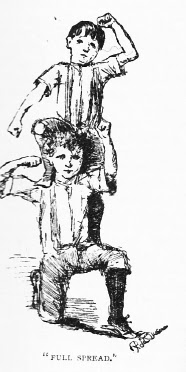
Their improved physique is possibly in a great measure due to the capital feeding they get, it being obviously to the advantage of the “father” to have a robust, rosy-faced company. Master Harris, of the “Yokohama Troupe,” informed me that he generally has meat twice a day, a bath every evening (gymnasts are compelled by the nature of their work to keep their skins in good condition by frequent bathing), that Mrs. Bale was as kind to him as his own mother, and that he thought performing “jolly.” He further informed me that he got three shillings a week for pocket money, which was put inton the bank for him.

Another boy in the same troupe told me he had over £9 in the bank. Of course, all companies are not so well looked after as the boys in Mr. Bale’s troupe; but I have failed to discover a single case where the boys seemed ill-used. Where the troupe travelled about Europe, the lads were exceptionally intelligent, and several of them could talk fair French of German. A really well-equipped acrobat is nearly always sure of work, and can often obtain as much as £30 a week, the usual payment being from £20 to £25 a week. As a rule, the boys remain with the master who has given them their training, and who finds it worthwhile, when they are grown up, to pay them a good salary. A troupe gets as much as £70 or £80 a day when hired out for fetes or public entertainments. There is one point which will possibly interest the temperance folk, and which I must not forget. The boys have constantly before them moderation in the persons of their elders.

“Directly an acrobat takes to drinking,” said Mr. Bale, impressively, “he is done for. I rarely take a glass of wine. I can’t afford to have my nerves shaky.” Altogether there are worse methods of earning a livelihood than those of the acrobat; and a propos of this point, an instructive little story was told me which sentimental, fussy people would do well to note. There was a certain little lad belonging to a troupe the owner of which had rescued him from the gutter principally out of charity. The boy was slight and delicate-looking, but good feeding and exercise improved him wonderfully, and he was becoming quite a decent specimen of humanity when some silly people cried out about the cruelty of the late hours, and so on, and insisted that he should be at school all day. The lad, who was well fed, washed, and clothed, was handed back to the care of his parents. He now certainly attends school during the day, but he is running about the gutter every evening, barefooted, selling matches till midnight!

On the subject of ballet children there is also a great deal of wasted sentiment. All sorts and descriptions of children are employed in theatres, from the respectable tradesman’s child to the coster’s child in Drury Lane; but the larger proportion are certainly of the very poorest class, and it must be remembered that these children would not be tucked up safely in their little beds, if they were not earning a few badly-wanted shillings; they would be running about he London streets.

Mr. D’Auban – who has turned out a number of our best dancers, such as Sylvia Grey, Letty Lind, and others, - was kind enough to call a rehearsal of his children, who are now performing at the Lyric, Prince of Wales, Drury Lane, and other theatres, so that I was enabled to see a very representative gathering of these useful little breadwinners. Whatever else may be urged against the employment of children in theatres, there is not the least doubt that dancing is a pure pleasure to them. Out of all the little girls I questioned, not a single one would admit that she ever felt “tired.” A good many of the children belong to theatrical families, and have been on the stage since they were babies; they were distinguished by a calmness and self-possession which the other little ones lacked; but in the matter of dancing there was very little difference, and it was difficult to believe that a large proportion of the children now playing in “La Cigale,” knew nothing about dancing six months ago. Mr. D’Auban has no apprentices, no agreements, and no charges, and he says he can make any child of fair intelligence a good dancer in six months.

The classes begin in May, and, as soon as it is known that Mr. D’Auban wants children, he is besieged by parents with little maids of all sizes. The School Board only allows them to attend two days a week; but Mr. D’Auban says: “Everything I teach them once is practiced at home and brought back perfect to me.” The children wear their ordinary dress, and practicing shoes of any kind are allowed. First the positions are mastered, then chasses, pirouettes, and all the rest of the rhythmic and delicate movements of which ballets consist.

Many of these graceful little dancers are the real bread winners of the family. Little Minnie Burley, whose charming dance in “The Rose and the Ring” will be remembered, though only eleven years old, has for more than a year practically supported herself and her mother by her earnings. The mother suffers from an incurable spinal complaint, and, beyond a little help which she gets from another daughter who is in service, has nothing to live upon but the little one’s earnings. During the double performance of the “Rose and the Ring,” Minnie earned £1 5s. a week; now she is earning as a Maypole dancer in “Maid Marian” 12s. a week: but her engagement will soon end, and the poor little maiden, who has the sense and foresight of a woman of thirty, is getting rather anxious.

She is a serious-faced, dark-eyed child, very sensible, very self-possessed, and passionately fond of dancing. Her mother is devoted to her, and keeps her exquisitely neat. I asked her whether she did not feel a little nervous about the child coming home alone every night from the Strand.
“No,” said Mrs. Burley, “you see, she comes by ‘bus, and she knows how to take care of herself – she knows she is not to let anyone talk to her.”

Minnie is a type of dozens of other hard working, modest little girls who are supporting themselves, and very often their families, by dancing. As a rule, the mothers fetch the children, or make arrangements for several to come home together. Many of them, whose husbands have been out of work, or who are widows, or deserted, have assured me they could not possibly have got through the winter without the children’s earnings, whilst the children themselves are immensely proud of “helping” mother. The pride they take in their parts is also very amusing. One small girl ran after me the whole length of a street. She reached me breathless, saying, “Don’t forget I’m principal butterfly.” Another small mite gave me a most crushing reply. She made some allusion to her mother, and I said innocently, “I suppose your mother is a dresser?” She looked daggers at me, and said indignantly, “My mother’s a lady wots in the ballet.”

The wages of the children range from 6s. to 16s. a week, and, as their engagements often last for four months at a time, it will be seen that their money is a valuable, and in may instances an essential, addition to the mother’s purse.
Child models, being required almost exclusively in the daytime, are, thanks to the vigilance of the School Board authorities, becoming more and more scarce. The larger number of them comes from “model families,” the mother having sat herself, and having from an early age accustomed their children to “sitting.” The children of these families have no difficulty in obtaining regular work; they get a reputation in the painting world, and one artist recommends them to another. In the neighbourhood of Fitzroy Square, Holland Park, and St. John’s Wood these families abound, and are mostly in respectable circumstances. A pretty little girl, whose mother is a well-known model, and who has herself figured in several of Millais’ pictures, told me with condescension that she had so many engagements she didn’t know which artist to go to first.

Mary M–––, whose face is familiar to admirers of Miss Kate Greenaway’s pictures, is, except for a couple of months in the summer, never out of work. She is a beautiful child of fourteen, the daughter of a cab-driver, who is not always in regular employment; and, as Mary has a tribe of little brothers, her earnings are of the utmost usefulness. For several months she has been sitting to three artists, and making the very respectable sum of £1. 10s. a week.
In her spare moments Mary takes music lessons, and her great ambition is to become an illustrator in black and white. All her earnings are cheerfully handed over to her mother, who is careful of her little daughter’s welfare as can be.
“I don’t sit as a nude model,” Mary said, “but only for my head, and mother doesn’t let me go into any studio.”

As a matter of fact, children are not used as nude models to any great extent; they do not sit still enough, and their limbs are too thin and unformed to be of much use. Besides the regular professional models, who get 5s. a day, and are pretty sure of engagements, except in the summer, there is a fairly large class of street children who call at the different artists’ studios, and are taken on occasionally.
“I get any number,” said a well-known artist. “They come down to me, and are kind enough to suggest ideas. One small girl said to me the other day. ‘could you do me in a blue dress, sir; mother says it would go well with my golden ‘air.’”

Many artists prefer these children to the regular model, who get a stereotyped expression and artificial poses from long habit. Mr. T.B. Kennington, whose pictures of poor London children are familiar to the public, told me that he always actually paints from the class of children that he depicts on his canvas. The boy whop figured in that painful and powerful picture of his, “Widowed and Fatherless,” is a real little London waif.

"Widowed and Fatherless" T.B. Kennington, 1888
 His mother is said to have been pitched out of window by her husband, and the boy, whose sad face arrests the attention of the most careless observer, lives with his grandmother, who does washing.
“Do you make the children ‘put on’ this sad expression?” I asked Mr. Kennington.
“No, indeed; my great difficulty is to make them smile, except momentarily. Haven’t you ever noticed how melancholy children look in repose?”
This may be true about children who are constantly half-starved and ill-treated, but surely it is not true of children in general, or even of the majority of children of the lower classes, who contrive to wear an air of marvelous brightness, in spite of cold, hunger, and even blows. “Sitting” does not seem to be an occupation that commends itself to children, who naturally dislike keeping perfectly still in one position. Nearly all the little models prefer ladies, who keep them quiet by telling them stories, and bestowing sweets and cakes on them; whereas male painters have less persuasive methods of making them do what they want. These latter, however, make many attempts to reform the manners and morals of their small models, many of whom, they say, evince an appalling amount of depravity.

Mr. F.W. Lawson, who painted some veritable little slum waifs, in his series of pictures called “Children of the Great Cities,” told a good little story of one of his attempts in this direction. His model was a small, bright-faced, black-eyed street boy.
“Well, Fred, what have you been doing today?” asks Mr. Lawson.
“Playing on Battersea Bridge, sir, and chucking stones at mad old Jimmy,” was the reply of the urchin, who then proceeded with much gusto to describe the details of this sport.
Mr. Lawson, on learning that mad old Jimmy added blindness to his other infirmities, spoke strongly about the cruelty and cowardice of such an entertainment; and ended up by telling a story of a heroic deed by a blind man.
“When I looked up,” said Mr. Lawson, “I saw the boys eyes were full of tears, and I thought to improve the occasion by asking, ‘And now, Freddy, what will you do if you meet mad old Jimmy again?’ The little scamp looked up with a wink and said, chuckling, ‘Chuck stones at ‘im, sir.’”

Professional models, especially those who have sat to eminent artists, have an exaggerated idea of their comeliness, and they will draw your attention to their good points with much frankness.
“I’ve got beautiful ‘air.” Said one little girl, modestly pointing to her curly, chestnut locks; whilst a small boy, usually called the “Saint,” from having figured in several religious pictures, requested me to observe his “fine froat,” as if he had been a prize beast.

In London, owing to the numerous restrictions imposed on employers, there are only a comparatively small number of children working in factories. Girls of thirteen and upward are employed in confectionary, collar, jam, and match and other factories where skilled labour is not required, whilst small boys are principally found at rope works, foundries, and paper-mills, where their chief business is to attend to the machinery. It is almost impossible to mistake the factory-girl, and even at a glance one notes certain characteristics which distinguish her from her sister workers. Contrast her, for instance, with the theatre child out of Drury Lane. The little actress may be as poor as the Mile End factory girl, but in nine cases out of ten she will be neatly clad, with spotless petticoats and well-made boots and stockings. If you watch her, you will notice she walks gracefully, and instinctively assumes, whenever she can, a picturesque and taking attitude.
The little factory girl is decently enough attired so far as her frock is concerned, but she, or her mother, cares nothing about her boots, which are invariably cheap and untidy, whilst any superfluous coin is devoted to the adornment of her hat, an article of great importance amongst factory-girls – young as well as old. But a still more characteristic feature, which, so far as I know, is peculiar to factory-girls, is their curious method of walking, which is carefully cultivated and imitated by the young ones. It is a sort of side “swing” of the skirts, and has one of the ugliest effects that can be produced, especially when executed by half a dozen young ladies walking abreast on the pavement.

At Messrs. Allen’s chocolate and sweet factories, in Mile End, some two hundred women and girls are employed. Referring to the strike, I asked a highly respectable, intelligent-looking girl, why she joined it:
“Well, I don’t hardly know,” was the candid reply. “It was all done in a rush, and the other girls asked me to come out.”
This girl was earning, by the bye, 17s. a week.

The quite young girls are principally employed in packing chocolate into boxes, covering it with silver paper, which operation they perform with great dexterity, labeling, and other easy work of this nature. The rooms are large and well ventilated, and each department is under the care of a forewoman, who not only keeps a sharp look-out on the work, but exercises what control she can have over behaviour and conversation.

The discipline did not strike me as particularly severe, considering that the girls left their work en masse, as soon as one of their number had announced, referring to the artist, “She’s takin’ Em’ly’s likeness.”
The hours, from 8 to 7, are certainly too long for girls in delicate health; but the work itself is light, and a capital dining-room is provided on the premises, where the girls can cook their dinners and make themselves tea. Nor are the prospects at all bad. Here is Alice C –––, a girl of fourteen, the daughter of a flower carman, not always in work. She is a packer, and gets 6s. a week, which she hands over to her mother. She says she likes doing things with her hands, and would not like to be in service, as then she wouldn’t have her Sundays to herself. If she stays on at Messrs. Allen’s, her wages will be steadily raised to 18s. a week; and, if she ultimately becomes a piece-worker, she may make as much as 24s. or 25s. a week.
Considering that a good many educated women are teaching in High Schools for salaries of £65 per annum, this is surely not bad.

Of course all factories are not as well managed as these chocolate works, and where the hardship comes in is where hands are turned off at certain periods of the year, or when the work itself, like match-making, is injurious to health.

Still more unfortunate is the lot of some of the little girl workers who assist their mothers at home in tailoring, button-holing, and dolls-clothes making. The united work of mother and child yields only a wretched pittance, and, carried on as it is in a room where sleeping, eating, and living goes on, is, of all forms of labour, the saddest and most unhealthy. Meals consist of bread and tea, and work is prolonged till midnight by the light of one candle, with the consequence that the children are prematurely aged and diseased. This is the most painful kind of child-labour that I have come across, and would be unbearable, if it were not ennobled by the touching affection that almost invariably exists between the worn-out mother and her old-woman-wise little daughter.

The lot of the child-vender in the streets would be almost as hard, if it were not, at any rate, healthier. Terrible as are the extremes of weather to which the little flower-girl or newspaper boy is exposed, the life is in the open air, and a hundred times preferable, even if it results in death from exposure, to existence in a foul-smelling garret where consumption works its deadly way slowly. Children find an endless variety of ways of earning a living in the streets. There are the boot-black boys, who form a useful portion of the community; newspaper boys, of whom the better sort are useful little capitalists, with an immense fund of intelligence and commercial instinct; “job chaps,” who hang about railway stations on the chance of earning a few pence in carrying bags; flower-girls, match-girls, crossing sweepers, who can make a fair living, if they are industrious; and lastly, although this enumeration by no means exhausts the list – street prodigies, such as pavement painters and musicians. All Londoners must be familiar with the figure of little Master Sorine, who sits perched upon a high stool diligently painting away at a marine-scape in highly coloured chalks.

This clever little artist of eleven is the principal support of his parents, who do a little in the waste-paper line when there is anything to be done. As a rule, Master Sorine is finishing his marine picture or landscape when I pass by, so that I have not had an opportunity of judging of his real ability; but his mother, who keeps guard over him, assures me that he can draw “anything he has seen” – an assertion which I shall one day test. The little fellow is kept warm by a pan of hot charcoal under his seat, which would seem to suggest rather an unequal distribution of heat. However, he seems to think it is “all right.”

His artistic efforts are so much appreciated by the multitude that on a “good day” he earns no less than 9s. or 10s., which mounts up to a respectable income, as he “draws in public” three days a week. Master Sorine, however, is exceptionally fortunate, and indeed, there is something particularly taking about his little stool, and his little cap, and the business-like air with which he pursues his art studies. Nothing can be said in praise of such “loafing” forms of earning a livelihood as flower-selling, when the unhappy little vender has nothing but a few dead flowers to cover her begging; or of “sweeping,” when the “crossing” of the young gentleman of the broom is often dirtier than the surrounding country.

Now and again one comes across industrious, prosperous sweepers, who evince a remarkable amount of acuteness and intelligence. It may have been chance, but each of the crossing sweepers I questioned were “unattached,” disdained anything in the way of families, and declined to name their residence on the ground that they were “jes’ thinkin’ o’ movin’.” This is a very precarious method of earning a livelihood, and is generally supplemented by running errands and hopping in summer.
In a wealthy neighbourhood, frequented by several members of Parliament, who were regular customers, a very diligent young sweeper told me he made on average in winter 2s. 6d. a week; but he added contemptuously:
“Business ain’t what it used to be. Neighbour’ood’s goin’ down, depend on it. I’m thinkin’ of turnin’ it up.”
This young gentleman supplemented his income by successful racing speculations, obtaining his information about “tips” from his good-natured clients. It seems sad to think how much good material is lost in these smart street boys, whose ability and intelligence could surely be turned to better account. The most satisfactory point – and one which no unprejudiced person can fail to recognize – in connection with the subject of child-labour is that healthy children do not feel it a hardship to work, and that, therefore, considering, in addition, how materially their earnings add to their own comfort, all legislation in the direction of restriction and prohibition ought to be very carefully considered.

I must express my best thanks to Mr. Redgrave, of the Home Office, for his help in obtaining entrance to factories, and to Mr. Didcott, the well-known theatrical agent, for his kind services in the matter of acrobats.
             - Strand Magazine, 1891

The Strand Magazine ran for almost sixty years, before ceasing to be in 1950, however, it was brought back into publication in 1998, and has a website; strandmag.com

Anyone interested in articles of this ilk, or lesser-known works of fiction by popular authors of the past would be well-advised to look on eBay, or search antique book shops for bound editions of this magazine, as they really do contain some interesting work.

Returning to the subject of Victorian children before I close, to offer a little contrast I may return to The Strand for another article on Victorian children in the near future, but on a somewhat brighter note.

Finally, in closing, a picture of the modern-day Strand!


Wednesday, 3 November 2010

Working Children of the 19th Century

From the horror of Hallowe’en to a different type of horror now, namely that of the destitute and poor children of the 19th century who were forced to scrape a living together doing things that today, we are lucky that laws no longer allow.
There were so many less than desirable jobs in Victorian Britain, but in the interest of keeping these blogs relatively short and therefore quite readable without having to make too much of a commitment, I have chosen, for now, four such jobs from various parts of the country;

  • London Street Urchins
  • Lancashire Cotton Mill Labourers
  • Midlands Brickmakers
  • Thames Mudlarks

Though, no doubt at some point in the future many other occupations of the poor will be discussed here. 

London Street Urchins:
We begin (almost predictably) with a James Greenwood piece from his anthology; “IN STRANGE COMPANY”
I have reproduced the chapter entitled “Three of Ten Thousand” in which he tempts urchins of various “trades” from the streets with the promise of a job, and interviews them:

"THE Angel at Islington, from which every minute almost through the livelong day omnibuses from all parts of London are setting down and taking up their loads of passengers, is a favourite hunting ground with the juvenile ragamuffin horde, who, for their sustenance, are driven to beg, or steal, or legitimately trade, as occasion may serve. Day and night you may find them there - paper boys, fusee boys, crossing-sweeper boys, and boys out of number who are nothing in particular "at present," three-feet-high merchants, ruined through rash speculations, and "rubbing on" until a lucky windfall sends them a sixpence with which to go to market again; dirty, houseless, poor little gutter prowlers, who ever keep a bright look-out, are never downhearted, live on from day to day, and at night find shelter for their capless, unkempt heads, God only knows how.
    You may always find them there; and there they were as that miserable winter's day, last Thursday, was closing in with drizzling rain that was ten times colder than snow. There they were, and it came into my head quite suddenly that an hour might be worse spent than in sampling the bulk and hearing from their own lips what were their present means and future prospects in that state of life to which hard fortune had doomed them.
    As though divining my thoughts, at that moment there leaped out of the mud, right under my nose, one of exactly the sort on which my mind was dwelling - a poor shoeless shuffling little wretch, whose entire suit consisted of a pair of manly trousers ingeniously secured by a single brace over a dilapidated shirt of the Guernsey order, and whose stock-in-trade was five or six cakes of boot blacking, contained in a box slung round his neck.
Tuckered Out: The Shoeshine Boy: John G Brown 1888
The box had no lid, and the rain was so rapidly liquefying the paper-covered cakes, that the one he held out for me to buy drooped across his mite of a hand - deadly white with cold where it was not black with grime - in a manner not calculated to tempt a person who was some miles distant from home, and who really was not urgently in need of blacking.
    "Buy a a'porth," pleaded the small boy, "here yer are, take three on 'em for a penny; that won't hurt yer"
    Great was the boy's amazement when I bade him go and wait a little while for me at the corner of the next street, and I would show him how he might earn a shilling easily.

    My next capture was a fusee boy, a little younger-looking than my blacking boy; but I wanted still another, and presently I espied him, a red-haired boy, a sturdy broad-nosed freckled villain of eleven or so, who scorned trade, and was a lawless savage. When I set eyes on him he was in a fierce conflict with a boy older and bigger for possession of a crumpled-up paper of that evening's issue that some one had thrown from the roof of an omnibus. Encouraged by the cries of "Go it, Ginger!" yelled by his admiring friends, the red-haired boy presently finished his antagonist by scientifically butting him with his bullet head in the pit of the stomach, and bringing him to the ground; after which Ginger retired to the pavement, and, waving his captured prize most aggravatingly before the eyes of the vanquished, with calm precision executed a war dance.
    A quarter of an hour later we four - the blacking boy, the cigar-light vendor, Mr. Ginger, and the reader's humble servant - were comfortably bestowed in the parlour of a little alehouse in the Pentonville Road, with bread and cheese before us, and a glorious fire burning in the grate, in the fender of which my thrifty blacking-boy laid out his little stock to dry.
    Ginger's delight when the landlord brought in along with a big loaf the half of a huge Cheshire cheese, was a sight to behold; his amazement when the landlord left the room, leaving the half cheese behind him, I will not attempt to describe.
    "He's forgot it, ain't he?" he said, handling his knife as though sadly tempted to make the most of the innkeeper's mistake by slicing off a pound or so.
    "No, he hasn't forgotten, my lad," said I, "he'll fetch it away when we have done with it."
    "When we have done with it! What, are we going to eat as much as we likes on it?"
    "Yes."
    Ginger lost not a moment more. Licking his lips as I cut him a liberal slice, he pounced on it and on a hunch of bread with a degree of voracity that spoke of long fasting.
    Ginger ate with his elbows on the table-nay, with both his arms and hands forming a jealous barrier round his food, just as the brown bear at the Zoological Gardens encircles with his paws the meal of biscuits the keeper throws to him in his den. As he munched each greedy mouthful, his fierce eyes marked the next in the crisp crust, in the luscious cheese that yielded but too faint a resistance to his grim semicircle of teeth. I can't say how much that half cheese weighed, probably thirty pounds, but it was evident that Ginger had promised himself that he would eat the whole of it, and the spasm of pain it caused him to see me help the other two was ludicrous to behold. The second, the third time, he thrust his plate for another helping, and still once again, and with a chuckle of triumph as the blacking-boy and the fusee-boy announced that they had had enough. The champing of his insatiable jaws was the only sound that was heard, while his mates sat silent and expectant of information as to what was the "job" I had spoken of. At last I ventured mildly to remark to Ginger,-
    "When you are quite full, my young friend -" To which he promptly responded,- "All right, guvner, I ain't a greedy cove; I'll knock off now, if you like," and bolting at a gulp about two square inches of cheese that remained on his plate, he announced himself at my service.
    I explained briefly that, in the first place, I wished to know where was their home, and what their means of living; and I first addressed myself to the blacking-boy.
    "I am nine and a half," said he, "and I lives in Playhouse Yard, in Whitecross Street. It ain't a house, at least it ain't a house what you goes in-doors to, with tables and chairs and that, and a fire."
    "Ah, ah!" remarked Ginger; "no, there ain't much room for furniture in Billy Taggs's house, but it's werry comfortable, and, wot's more, it's regler. It's a barrer."
 "A baker's barrer," poor little Taggs hastened to explain - "one of them with a lid. The baker lets me sleep there, and I watches out for the cats."
    "For the cats?"
    "It's down a yard with gates to it where the barrer is and the baker he keeps breeding ducks and pigeons there and the cats come and nail 'em o' nights, and when I hears em I gives the lid of the barrer a histe, and down it comes with a whack, and they are off like a shot."
    "Are your parents alive?" I asked him.
    "I ain't got no mother, I've got a father; I sees him sometimes. He don't live up my way, he goes to fairs and that. I ain't got no brothers. I've got a sister she's in the hospital. She used to work up Mile End I way, at the lucifer factory, till she got the canker making of em. She's been in the hospital this ever so long. That's why I don't sell 'lights.' I can t bear the sight of em. I'm on my own hands. I earns all I gets. I've been adoin' it ever since she was took to the hospital."
    "Are you ever ill?"
    "I haint been ill a long time, not since the middle o' summer, when I had the measles. No, I dIdn t sleep in the baker's barrer then. I didn't know him. I knowed a pipemaker, and he let me lay in his shed, and his missus was werry kind to me. I do werry well. I hardly ever goes without grub. I don't know what you mean by 'regler' grub. I most times saves three-half-pence for my breakfast, and this cold weather I gets a ha'porth of bread and a penn'orth of pea soup; there's lots of shops what sells penn'orths of soup in Whitecross Street, ha'porths too. I sell out somehow every night. I gets a dozen cakes of blacking for tuppence - ha'penny, and I in general clears about fivepence. Dinner time I get's a baked tater, or sometimes a ha'porth of fried fish. All I got left, cept three- half-pence for breakfast and stock-money, we spends at supper-time."
    "We goes together, four or five of us, sometimes to the soup shop, sometimes to the baked tater and fish shop. It's all right mostly; course there is hard times. Once a p'liceman took away my box, blacking and all, cos I cheeked him. It was more'n a week before I could make another start. I washes myself sometimes, not often; I ain't got no towel and soap. I don't recollect when the last time was. It was afore the frost, though, cos I know it was a wrench at the pump I had. Yes, sometimes I wears boots. I ain't had none since the last boat-race day, Cambridge and Oxford, and I lost one on 'em turning cat'n wheels behind a carriage."
    "Were you ever in trouble?"
    "I never was locked up; cert'ny not. Don't I think I should be better off in the workus? No, I don't want to be shut up anywheres. I am all right. I don't want nobody to be a-looking arter me like that, thanky all the same, mister."
    "Can you read?"
    "No, I can't read, nor write neither; I never was in a school. Never was in a church. I don't like to be shut up anywhere. I'd a jolly sight rather go on as I'm a goin.'"
    And so he retires to collect his blacking out of the fender with a dismal foreboding, as I can see that he may, after all, in consequence of his sturdy determination to embark in no business that may involve his "being shut up," though for never so short a period, miss my "job" and the promised shilling after all.
    The fusee-boy comes next; but his experiences are tame and commonplace compared with those of the blacking-boy. He is a meek and spare-looking little chap, woefully ill-clad and dirty, and his age, as he informs me, is "summat about eight or ten." He refers to Ginger, who is a personal friend, for definite information on the matter.

Street Urchins
Ginger opines that, as "nigh as a toucher, he was eight last birthday." The fusee-boy was better off than Billy Taggs, inasmuch as he had a mother and "regler lodgings;" but the advantage was not unalloyed, for the fusee-boy's mother was what Master Ginger described as a "lushing, fightin' sort of woman, who was wuss than a scalded cat to them about her when the drink was in her."
    "I'd rather be without a mother than have a oner like her," said the red-haired boy; "there's him and his two young brothers and his sister wot sells buttonolers (flower-sprigs for the button-hole), and she grabs all they earn, and get's drunk with the money, and punches them about orful cos they don't bring her more. Their only good time is when she is in quod. She is there now for twenty-one days, for saultin' a policeman on Christmas Eve. Good job if she was dead. Yah! yer young fool!" continued the ferocious Ginger, as the small pale boy raised to his dirty eyes his dirtier cuff; "he always snivels when you tell him that."
    Were his brothers older than himself? I asked.
    "One was older," the fusee-boy replied, and one was two years younger, and they were all out selling lights. The sister was the eldest of all. Thirteen she was, but she wasn't very big because of her humpty back." She can't get no flowers now it's frosty, so she gets paper bags to make, and stops at home to look arter the wittles and that, agin we comes home at night."
    "Are you out all day long, then?"
    "All day long, up to about nine."
  "But you go home to your meals?"
    "There ain't no meals, 'cept the coffee in the morning, and what we gets when we go home at night."
    "And what do you then get?"
    "Oh, all manners ; stews sometimes," and his dirty little white face lit up at the glorious recollection.
    "Jolly fine stews they are," put in the irrepressible Ginger; "I've paid my whack towards em, and joined in. We should ha' had one to-night, only his sister Becky hain't good on her pins when it's slippery, and it's a long way over to Bermondsey."
    "Why to Bermondsey?"
    " Cos you can't buy bits and ears 'cept in the skin market."
    "Bits of what and ears?"
    "Bits of meat what they scrapes off the insides of the skins and the ears of the bullocks; stunnin' stew it makes with an ingun and a few taters."
    "And how much a pound do you pay for the - the ears and bits?"
    "Nothing a pound; you buys it in lots. Them wots got the priwilege cuts 'em off and makes 'eaps of 'em on the pavement, about a couple of pound for twopence. That's how his sister Beck looks arter em when she's left to herself, yet he ses he shouldn't be glad if his old woman was dead!" And the red-haired boy disgustfully snorted his scorn for self-damaging weakness in general.
    To the cigar-light boy I put the same questions as to the blacking-boy.
    "Did he ever go to church?"
    "No."
    "To school?"
    "No."
 "Could he read or write at all?"
    "No; he knew nothing about them things," the fuseeboy answered listlessly.
    "Ah, but he can do something wots a lot better!" exclaimed Ginger, with an admiring glance at his young friend; "he's a fizzer on the whistle."
    "On the whistle?"
    "The tin-whistle-don't yer know?" and taking up a long piece of bread-crust from the table he made on it the motions of a flute-player; after which he put it in his pocket.
    "He ain't got the cheek to go into public-houses and that, or else he might make a reg'lar good living of it."
    There must have been something more than empty flattery in Master Ginger's eulogium of his friend's whistling powers, for the little pale boy brightened up wonderfully.
    "Mister," said he to me, with much more animation than he had yet displayed, "did you ever hear that boy what plays in a coffee-pot?"
    I was fain to confess that I was ignorant of the existence of the phenomenon in question.
    "He don't mean in it, guv'nor; he means down the spout of it," explained the ready Ginger; "the chap he means goes about playing down the spout of a coffee-pot, just like as though it was a whistle. He very often makes a pitch in them streets that leads out of the Strand."
    "And would you like to go about playing tunes on a coffee-pot?" I asked the little cigar-light boy.
    "Better'n everything," returned the modest small musician; and, then, finding that I had nothing more to say to him, he joined the blacking-boy, who had by this time repacked his dry goods, and was now dozing by the fire.
 "My name is John Galloper," remarked the red-haired boy, before he was asked the question, and folding his hands behind him, after the fashion of good little boys, when repeating a catechism lesson.
    "And how do you get a living, John?"
    "You don't want to hear no lies, mister."
    "Certainly not."
    "Then I don't get a living at all; I lets the living get itself."
    "But you must either provide for yourself or somebody provides for you; which is it?"
    "It's a kind of mixshure of both, I suppose," returned John Galloper, with a laugh, and, after a little reflection, "it comes somehow; I don't trouble myself."
    "How old are you?"
    "Older than you might think," answered John Galloper, with the wink of a middle-aged horse dealer; "I am thirteen last birthday."
    "And you do no work?"
    "I ain't above a job, if I tumble across it.
    "Sometimes you beg?"
    "Per'aps you might call it beggin'."
    "Sometimes you steal?"
    "Oh! come, yer know, you're a-comin' it a little too hot now. It's a mixshure. I tell you you'd better call it a mixshure, and say no more about it. What's the job you brought me here to do, guv'ner?"
    "Wait a little: where do you live?"
    "I don't live anywheres. I ony lodges in Golden-lane - sometimes at the 'Nussery,' sometimes at Dunn's."
    "Have you a father or a mother?"
    "I d'n know; I hain't been to see this year and more. They don't care nothing about me, and I don't want 'em to."
 "I tell you what, my young friend, it seems to me that unless you alter your ways there can be little doubt as to what the end of all this will be."
    John Galloper broke off a bit from the purloined crust in his pocket, and calmly masticated it as he looked up to the ceiling.
    "You'll become a convict, and sent to drudge in misery to the end of your life in some stone quarry."
    "Ah, all right," said John Galloper, evidently growing restless; "we'll see about that when we gets there. What's the job, master?"
    "I didn't bring you here to preach to you, but I must tell you it is terribly distressing to find a little lad like you so reckless as to what becomes of him. If you could seriously -"
    "Oh, that's enough of that. Don't you fret about me, mister; I knows my way about. Now, what's the job?"
    There was no use in further talking, and so the "job" was at an end, very much to Mr John Galloper's amazement when I announced the fact. So I gave them a shilling each, and let them go back to the mire where I had found them. I don't know if it was the effect of the cheese of which with my young friends I had partaken, or whether it was the influence of their strange company, but that night I lay much awake, thinking of poor Billy Taggs bemoaning the worry of cats as he tumbled and tossed in the friendly baker's barrow, and of the pale little fusee-boy, tucked as warmly as may be in his wretched bed by his little hunchback sister
, and dreaming of the genius of the coffee-pot, and of desperately wicked young John Galloper, and of what, one of these days, would inevitably come out of his pernicious mixshure."

Lancashire Cotton Mill Labourers:
During the Industrial Revolution, Manchester became one of the main manufactories of the cotton. Largely, this was made possible by the new transport developments of trains and canals between Liverpool (which was the North West’s main point of import by sea for raw cotton from plantations in America – and later Egypt and India) and Manchester, thus allowing a route for the cotton from the port to Manchester. Once in Manchester, the cotton was turned to yarn in cotton mills, which lead to a huge increase in the number of cotton mills in, not only Manchester, but most of the surrounding towns in Lancashire.

The cotton mills employed many children, as they could be paid a pittance and kept in control by the foremen using strict and often violent discipline. They were also small and nimble enough to crawl under the textile machinery and spinning ‘mules’ and sweep up any dropped strands of cotton. This job was life-threatening, and plenty of children got limbs trapped in the moving parts of the machines whilst they were underneath them collecting cotton. These mills would also have been dusty and dirty places, and with no fresh air or safety equipment the employees breathed in huge amounts of dust.
The strict rules in the cotton mills were very similar to those experienced by the matchgirls; lateness was punishable by fine. Mistakes, laziness and absence were all punishable by either fines or beatings.
Working in a Cotton Mill
This extract is taken from an interview with a Mr Rigby, born in 1901, and although he was working in a cotton factory in the early 1900s, little had changed since the Victorian period:

Where did you first start work?
When I was twelve I went to this school across the road here and when I was twelve year old I got my half time paper, which was a blue paper and I went and got on at the spinning mill at Atherton and I worked half time, that’s from morning at six o’clock and I think it was ‘til twelve an then I’d come running home, had my dinner and went to school at the afternoon.

What was your job in the spinning mill? What did you do?
Well my job in the spinning mill was a little piecer and eventually when I got to full time at thirteen I must have got on a bit because the made me into a side piecer. So that was a promotion over little piecer.


These are mules we are talking about?
They were the mules, the spinning mules, yes. I stuck there until I was
15.

What did you wear when you were doing that job?
Well you wore a pair of white pants and nothing on your feet.

Nothing?
Nothing at all on your feet. You walked about between the mules with
nothing on your feet making the ends up as they broke. Backwards and
forwards as the come out and went in.

Did you ever get splinters in your feet?
Yes you did get splinters in your feet and then you’d go to the first-aid
room and have it took out. All the time you were getting splinters in your
feet. With the continued walking, you know the continued walking, and
the oil, it got slippy with oil you know, it was like a dance floor, but that’s
the way it was in the spinning mill.
(Taken from the North West Sound Archive)

In 1828, John Brown, a journalist from Bolton, Lancashire, wrote a book based on the life of a child labourer called Robert Blincoe who worked in the cotton mills in Lancashire, here is an excerpt:

"The task first allotted to him was to pick up the loose cotton, that fell upon the floor. He was terrified by the whirling motion and noise of the machinery, and not a little affected by the dust and flue ... he was half suffocated. Unused to the stench, he soon felt sick, and by constantly stooping, his back ached. Blincoe, therefore, took the liberty to sit down; but this attitude, he soon found, was strictly forbidden in cotton mills. Smith, his task-master, told him he must keep on his legs. He did so, till twelve o'clock, being six hours and a half, without the least intermission.
.. he was promoted to the more important employment of a roving winder. Being too short .. to reach to his work standing on the floor, he was placed on a block. He was not able by any possible exertion, to keep pace with the machinery. In vain, the poor child declared he was not in his power to move quicker. He was beaten by the overlooker, with great severity. In common, with his fellow apprentices, Blincoe was wholly dependent upon the mercy of the overlookers, whom he found, generally speaking, a set of brutal, ferocious, illiterate ruffians. Blincoe complained to Mr. Baker, the manager, and all he said to him was: "do your work well, and you'll not be beaten."

This paragraph details the type of horrific accident that could befall these children:

“A girl named Mary Richards, who was thought remarkably handsome when she left the workhouse, and, who was not quite ten years of age, attended a drawing frame, below which, and about a foot from the floor, was a horizontal shaft, by which the frames above were turned. It happened one evening, when her apron was caught by the shaft. In an instant the poor girl was drawn by an irresistible force and dashed on the floor. She uttered the most heart-rending shrieks! Blincoe ran towards her, an agonized and helpless beholder of a scene of horror. He saw her whirled round and round with the shaft - he heard the bones of her arms, legs, thighs, etc. successively snap asunder, crushed, seemingly, to atoms, as the machinery whirled her round, and drew tighter and tighter her body within the works, her blood was scattered over the frame and streamed upon the floor, her head appeared dashed to pieces - at last, her mangled body was jammed in so fast, between the shafts and the floor, that the water being low and the wheels off the gear, it stopped the main shaft. When she was extricated, every bone was found broken - her head dreadfully crushed. She was carried off quite lifeless.”

This, despite the Education Act brought in by Gladstone in 1870 providing compulsory education for children up to the age of twelve, meaning all children below this age must attend school.

The death of child labour in cotton mills was not brought about until the early 1900’s, when the school leaving age was raised to fourteen, meaning (in theory, anyway) that all children under this age should be in school, rather than at work.

Midlands Brickmakers:

Another piece now from Greenwood, and this time he is writing about a trip to the Black Country. (the English midlands). Whilst there, he learns about the Oldbury brickfields, where youngsters gather clay from the clay-rich ground for the making of bricks. Phosphorous (or phossy) jaw also gets a mention at the start. For more on that, see my post about the matchgirls strike.

Onto Greenwoods article, which is from his compilation of work “Mysteries of Modern London” the chapter entitled “Girls of the Brickfields”:

“…The railway station at which you alight at the dreadful place is styled Oldbury and Langley Green. The murky air being saturated with an icy rain, I was glad to seek temporary shelter at a little inn a short distance from the bridge that spanned the pea-soup- complexioned canal. It was dinner-time, and there was company in the cosy, brick-floored parlour. Presently one who was partaking of cold pickled pork and bread with the help of a bowie knife, spoke:-
"Bill," said he, "did you see Frank this morning?"
"No, I didn't; queer, ain't he?"
"Rather. He's knackered - that's wot he is. It's got him by the jaws, and it won't let him go, you may bet."
"What's that?" somebody else inquired; "another one of 'em gone off from over the way? Serve him right - serve em all right if they will go chucking their lives away because the wages are high."
"What I say is," remarked a man eagerly, with a mouthful; "what I say is, they should take the tip in time if they're going wrong. When their teeth begin to fall out that's the time they should take the tip and cut it, and find a job somewhere else."
And so the subject was summarily abandoned as being too well worn and commonplace to pass current even as gossip. What was it that had got the unfortunate Frank "by the jaws" so inexorably as to justify the observation that he was "knackered?" What was it to be knackered, and what was the horrible thing to be avoided so soon as a man was forewarned of its approach by the falling out of his teeth. I waited in vain for a renewal of the conversation, and two o'clock presently struck, on which the company wiped their dinner knives on the legs of their trousers, pocketed them, and took their departure. All excepting one, by good luck, who seemingly had nothing better to do than to stay and finish his beer. Luckier still, he was that individual who had inquired of Bill respecting "Frank" and his woes. He was a young fellow, pale and sickly-looking, and, as he was deficient of several of his front teeth, I ventured, after we had exchanged a few commonplace remarks, to inquire if he had "taken the tip", as the man had advised. That started him, and in a very few minutes, if I might believe all that he told me, I found that I was never more mistaken in my life than when I imagined that Langley Green would prove to be an oasis in the ashy desert through which I had of late been wandering…
He informed me that the staple of the trade at Langley Green, otherwise Oldbury, was not bricks but chemicals, the manufacture of which gave employment to many hundreds of working men. Did I see that great grey hill yonder (a symmetrical mound many hundred feet in length, and at least a hundred and fifty in height)? Well, that was the refuse from the alkali works. Did I see those two tall chimney shafts? They belonged to the copperas works. An awful place to work in. The work turned you green; turned your teeth blue, and your hair grey, and played "old Harry" with your blood if the copper got into your system. Was it the copper that had got hold of the jaw of the person he had spoken of, I inquired? No, my obliging informant replied, it was phosphorus that did that. Those were the phosphorus works just opposite. He couldn't say how many men were employed there - three or four hundred very likely. Some of the hands could stand it, get fat and hearty on it, but not many. A man might fairly look to being "knackered" by the phosphorus before he had been at it many years. He had known dozens that had been, and he might be said to know something about it, since he had lived with his father and mother in that very public-house for three-and- twenty years. Teeth! 
He only wished he had as many sovereigns, as many shillings even, as he had seen dropped-out teeth that had been drawn in that parlour. Were the men who worked at phosphorus good public-house customers? Rather. Rare good gin drinkers! The worst of 'em was that they wanted a room all to themselves, no one else being able to sit with em on account of the smell. The stuff was that powerful in 'em that it would spoil even their Sunday clothes that they never worked in. The vapour of it was bad enough that came from the works when the wind blew that way. It turned you sick to breathe it, and rotted the window blinds and curtains and the clothes the women hung out to dry…The pale young man with a deficiency of teeth told me many other things circumstantially, with such dreadful detail that I at length felt almost sick, as though the wind had changed, and I was breathing the subtle "vapour" he had spoken of. So, inquiring of him the nearest way to the brick- fields, I bade him good day, thankful that all my teeth were safe and sound in my head, at present at all events.
Shrouded in chemical fogs and saturated with a drizzling rain, the brickfields at Oldbury did not wear a very inviting appearance, and least of all did they seem the sort of place where girls and women might be suitably and healthfully employed. I presume that it is the peculiar properties of the soil, combined with the near proximity of the railway and the canal, which have caused so great a part of Oldbury to be given up to the brickmaking interest; but one would like to know on what grounds it was originally decided that the production of baked blocks of clay for building purposes was work that women might be hired to assist at. More important still, how does it happen that in these enlightened and considerate days, when it is a question whether the tender sex should be employed at such laborious occupations as matchmaking and the setting up of printing types, sisters and wives are still permitted to toil in muck and mire, to handle pick and spade, and wheel loads of clay just as a "navvy" does, with a navvy's bare arms and horny hands, wearing the navvy's "ankle jacks," smoking the short pipe he smokes, swearing his oaths, and tippling his beer. Such samples of degraded feminine humanity I saw at twenty different spots, young women, middle-aged, and grey-headed, bare-legged to the knee many of them, and beplastered from head to foot with clay splashes, drudging harder than driven slaves ever yet drudged, and yet, withal, with a willing cheerfulness and strengthful ease that gave denial, to the theory of their unwillingly enduring hardship or ill usage…
The brick-making machines turned out the slack-looking cakes at the rate each of twenty-four a minute, but they were unequal to the task of supplying stuff enoughto fill the bakery ovens. Several other sorts of clay pastry claimed the attention of the brawny bakers, who, semi-nude, to accommodate their bodies to the tremendous heat, were, on account of perspiration and brick dust, of the complexion of Red Indians. Pipes for land drainage, likewise machine made, and resembling large sausage rolls preparing for a giant's picnic, were cooking and waiting their turn to be cooked; with all manner of tiles-fancy and plain- and chimney pots and massive slabs for pathway purposes, and numerous other articles made out of the plastic material the enormous mill provided, which the invention of the engineer is not clever enough to mould into shape.
A Young Girl Bakes Bricks
It would be well for humanity sake, and in the interest of womankind, if the making and baking of every brick and other device in clay could be done by machinery. As I write the words, the scene that prompted this last-mentioned sentiment appears vividly before me - the troop of girls at the steam mills, with smears and daubs of blue clay disfiguring their pale faces and making them hideous. I could not get them out of my mind during the remainder of the day on which I saw them, and they were at my bedside at night and disturbed my sleep…I had witnessed the lowest depths of degradation and repulsive drudgery to which the tender sex could be brought...There is the great heap of blue clay, and beside it is a wooden bench, and in single file they approach it and help themselves. I have spoken of them as clawing at the clay, simply because no other word expresses it. There is an implement just like a boy's archery bow for the common use; but the string is of stout wire. Selecting a jagged projection of the mass, a girl strikes at it with the bow wire and cuts it off as a cheesemonger cuts a cheese, and then clawing it up in her hands and arms she lifts it up on to the bench. A heavy load for a girl to carry you think-a half hundredweight at the very least. But stop a minute; she has only just commenced to make up her burden.
Ryan, the girl of sixteen or seventeen, tackles the wet blue clay heap, and clawing another lump as large, at least, as an ordinary parlour coal scuttle, poises it on her head. But she is not loaded up yet. She goes down on one knee, still balancing her head burden, grabs up a second lump nearly as large as the first, and, by a dexterous. movement and a wonderful amount of muscular strength, pitches up this second lump, and catches it on the one already resting on her head-the two lumps making a bulk nearly two feet in height. Now she is ready to take up the supplementary morsel, which is as. large as another coal scuttle, and. which she, in the first place, laid on the bench. She raises herself on her feet, with both her hands at liberty, hugs the reeking mass to her chest, and so staggers off to the moulder it is her duty to "serve."…I had previously timed the wretched-looking clay beplastered poor toilers, and found that they "loaded up," and performed their journey and came back again in about six minutes. To be on the right side, however, call it seven minutes and a half. That calculation shows that a "pug" girl carries at least half a ton of clay every hour, loading herself with every pound of it - five tons a day.
I further made inquiry of the friendly foreman what wages a clay-carrying girl could earn. His reply was 2s.,.and as he gave me this item of information with cheerful readiness, I came to the conclusion that, in his opinion, such a handsome rate of pay almost, if not quite, compensated for the exhaustive nature of the occupation. I question, however, if the reader will be of the same way of thinking. When one considers that five tons for 2s. represents less than 5d. per ton for self- loading and carrying, and recollects at the same time that a broad-backed six-foot coal-heaver would grumble tremendously were he asked to carry fifty sacks of coal-five tons-a distance of forty or fifty yards in a single day, it seems more than a little shameful that, with all our vaunted tender regard for our women and children, such brute drudgery as hauling and carrying wet clay should be still recognised as women's work.”
During the Victorian period, bricks were vital to the huge engineering works by engineers such as Brunel and Bazalgette. Railways, arches, tunnels, sewers &c. all made of brick because concrete was still in its infancy.
Children didn’t actually make the bricks. Instead they worked as bearers: the  “Bearer on” Carried wet clay from the pug mill where the clay was prepared, to the brickmaker’s table where the bricks were moulded. The “Bearer off” Carried the finished bricks from the brick maker’s table to the drying shed.
The brick makers worked for around twelve hours per day, six days per week.

In 1832 Samuel Smith, a Doctor from Leeds, described the effects of hard labour on a child’s body, those effects, he stated, were:

"Up to twelve or thirteen years of age, the bones are so soft that they will bend in any direction. Long continued standing has also a very injurious effect upon the ankles.
By long continued standing the knees become so weak that they turn inwards, producing that deformity which is called "knock-knees" and I have sometimes seen it so striking, that the individual has actually lost twelve inches of his height by it.
I have frequently seen accidents of the most dreadful kind. I have seen cases in which the arm had been torn off near the shoulder joint; I have seen the upper extremity chopped into small fragments, from the tip of the finger to above the elbow."

Mudlarks:
 Mudlarks had one of the worst jobs in 19th century London. They trawled the muddy banks of the Thames hoping to find something of value discarded from the docks, shipworks, or factories that lined the river.
Coal and brass were amongst the best finds a mudlark could hope for.

Here, Henry Mayhew, in “London Labour and the London Poor” tells us a little bit about the London mudlarks:

“Mudlark boys roam about the sides of the Thames river at low tide, picking up coals, bits of iron, rope, bones, and copper nails that fall while a ship is being repaired. They are at work sometimes early in the morning, and sometimes late in the afternoon, according to the tides.
They usually work from six to seven hours per day. My informant, a quick, intelligent little fellow, who has been at the business three years, tells me the reason they take to mudlarking. Their clothes are too bad to look for anything better, and they are nearly all fatherless and their mothers are too poor to keep them. So they take to mudlarking because they have nothing else to do.
This boy works with about twenty to thirty mudlarks every day, starting at daybreak very often, groping about and picking out the pieces of coal from the mud. They go into the river up to their knees, and in searching the mud they often run pieces of glass and long nails into their feet. When this is the case, they go home and dress the wounds, but they must return directly, for should the tide come up without their finding anything, they must starve that day.


Classic Image of a Mudlark
At first it is a difficult matter to stand in the mud. My informant told me that many young beginners fall in. the coals he finds, he sells to the poor people in the neighbourhood at a penny the ‘pot’ (about fourteen pounds in weight). The iron, bones, rope and copper nails he sells to the rag shops. They often pick up tools such as saws and hammers in the mud; these they either give to seamen in exchange for biscuits and beef, or sell to the shops for a few halfpence.

The mudlarks earn from about threepence a day. After they leave the river they go home and make themselves as tidy as possible, and then go into the streets and make a little money holding gentlemen’s horses, or holding doors open for the gentry. In the evening they go to the ragged schools if they can.

The boy I spoke to keeps his sick mother, who cannot work, by mudlarking. His sister helps by selling fish. The poor little fellow owes five shillings in rent. He has a suit of clothes and a pair of boots in pawn for four shillings – and if he could get them out of the pawnshop he could find some better employment.”

For our final excerpt, we go back to our old friend Greenwood, who tries to put a positive spin on one aspect of mudlarking; but ultimately fails, with this excerpt from the chapter on mudlarks entitled “Gleaners of the Thames Bank” from the 1867 compendium of his work; “Unsentimental Journeys: or Byways of the Modern Babylon”


“If there is a period when their position seems bearable, it is on a scorching August afternoon, when the pavement is hot to the tardy feet and the mind wanders to shady lanes and bathing places, when dusty errand-boys lean lazily over bridge parapets and envy the "larks" as they wade, leg high, in the cool river, and wish their fathers had 'prenticed them to watermen. But it is not August all the year round; and if those same boys should look down on to the shore a few months later (which they don't, for if they stand still on the bridge for a moment to look over, the north wind comes rushing up and cuts their ears off), in spite of the biting air-in spite of the masses of ice that are piled up here and there, reminding him of Esquimaux and Captain Ross-in spite of the frost-bitten craft that look like gigantic twelfth-cake ornaments-there are his envied friends of the summer, raking and poking, with never an extra rag to protect their crimson legs and arms. There they are, and there they will be, while tides rise and fall, and there is a pennyworth of anything to be found for the seeking on the river shore.”

In the 1860’s and 1870’s, the building of the Embankments put an end to much of the mudlarking trade, but they still exist in small numbers today; The Society of Thames Mudlarks, Founded in 1980, has a special licence issued by the Port of London Authority for its members to search the Thames mud for treasure and historical artifacts and report their finds to the Museum of London.

Last year, in 2009, one of the founder members, Tony Pilson, donated a collection of over two and a half thousand buttons dating from the 14th to the late 19th century, which he had collected along the Thames foreshore, read about Tony Pilson in this article from the Daily Mail from last year here

And the modern mudlark gets ready for his exhibition: here

Fortunately, we in the 21st century, and those of us who were children in the latter part of the 20th century never had to experience the working conditions of the poor in the 19th century – some of which I have described above.

Often, though, I wonder if the pendulum has swung too far in the opposite direction – not in terms of child labour, I must point out – in terms of the way we function as a society today. Whilst we should, of course, never go back to the working practices described here, we cannot deny that the kind of graft the children above showed in their lives and jobs made them survivors, and probably stronger and more determined if they reached adulthood – an attribute missing from so many of today’s youth.

As a people, have we peaked? Some areas in the world that these descriptions could still represent, most notably India, are moving up in the world economically, whilst us “lazy” and “mollycoddled” westerners who “live off the state” find ourselves in economic distress. There is a fascinating discussion to be had, I feel.