The People, Places, Events, Customs and More from the Victorian Era. Please Scroll Down to Explore Links to Other Sites of Historical Interest:

Thursday, 26 July 2012

"And Finally..." Or: The Joy of Old Newspapers:


One of my hobbies – much to the chagrin of Miss Amateur Casual – is collecting Victorian newspapers. Don’t get me wrong, I’m not a crazed hoarder; I don’t have piles and piles of mouldy old papers lying around, I have twenty or thirty Victorian papers (and I do keep them filed in nice folders!) and enjoy taking them out every so often to thumb through the pages and see what was happening in the news at the time of publication.

This, I find, is an excellent way of picking up the minutiae of an era. Little stories that faded away with the passing of not-very-much time at all can sometimes say more about the feelings of an age than the big events that still echo down through history today; and even if they don’t – it can still be very interesting to read stories and snippets that have been long forgotten.

(Incidentally, there is an excellent – but I fear now derelict – blog that scoured old newspapers for just these types of story, ‘An Extraordinary Incident’ found here is well-worth thirty minutes of anybody’s internet browsing time.)
But clearly I have mentioned my interest in such things out-loud, as it was detected by Thomas Walker over at the excelent historic-newspapers.co.uk who furnished me with three wonderfully presented copies of Victorian newspapers from which I have gleaned the following stories. The first concerns an Elephant. (Not for the first time in these parts; this post from almost two years ago about a runaway elephant in 1860’s Swindon was, I recall, quite popular when I originally published it, and is exactly the kind of wonderful story that I was talking about in my opening paragraphs. You can read it here: here )

And now onto our second elephant story:

Jumbo and his Friends
The large male African elephant at the zoological society's Gardens in Regent's Park has gained weekly and daily in popularity, since his refusal to go to the docks and embark for America, in accordance with the bargain for his sale to Mr. P. T Barnum and others at New York. Never were such crowds of visitors to the Gardens at this early period of the season, all thronging to the elephant house, or watching the huge animal in his customary promenade, in another part of the grounds, and offering him an unusual quantity and variety of eatables, while the eagerness of children and young girls to ride on his back is beyond all precedent. The number of people at the Gardens last Monday was twenty-four thousand; on Saturday, nearly seven thousand. There were 43,653 admissions last week


Engraving from the ILN taken from a photo by messrs. Briggs and son.
The newly constructed box, or van, in which it is hoped Jumbo will soon be removed to the docks at Millwall, if he can once be confined in it, is a massive vehicle, of the dimensions necessary for an elephant that stands eleven feet high, and that weighs between five and six tons. The frame of the van is composed of solid balks, morticed, bolted, and over all heavily clamped with iron. The flooring is of three-inch planks, and the sides and roof are lined with inch-and-a-half deal. The van is of such strength as is calculated to resist twice or thrice the force that even this powerful brute could possibly bring to bear against it. Important changes have been made in its formation, and still more in the trolley upon which it is fixed; so that, instead of being four feet above the ground, the floor of the van will only be raised about eight inches. It is, for the present, sunk to the level of the ground, which has been dug out for the purpose, and the floor covered with gravel. Axles of enormous strength have been fitted with special boxes and wheels, the width of the lower structure being governed by that of the gateway through which the van is to leave the Gardens. In the mean time, it is arranged as a kind of trap, with both ends left open, and being placed opposite the door of Jumbo's house, on the way to his exercise-ground and bathing-pool, he is becoming accustomed to walk through it, which he did for the first time on Saturday. The doors of the van will be suddenly closed upon him, at some convenient opportunity, when he is in chains, and the chains will be attached to the strong rings fixed inside the van, after which, it is thought, he cannot make any further resistance. The weight of elephant and van together will be about ten tons, which must be drawn by horses six miles through the streets from Camden Town to Millwall. Having reached the docks, a steam-crane will be employed to hoist up Jumbo in his box, and to put him into the ship which is to carry him to New York.

In the Chancery Division of the High Court of Justice last week Mr. Justice Chitty refused to grant an injunction restraining the Council of the Zoological Society from selling this elephant and Mr. Barnum's agent from removing him to America. The injunction was applied for by Mr. Berkeley Hill, one of the Fellows of the society, whose counsel argued that it was not legally in the power of the Council so to dispose of animals valuable for the study of natural history. Dr. P.L Sclater, the secretary of the Gardens, and Mr. A.B Bartlett, superintendent of the Gardens, were called as witnesses to state that it would be inconvenient, and perhaps dangerous, to keep Jumbo there till the age when he would become liable to certain fits of rage. The application was, therefore, dismissed by the court. 
 - Illustrated London News March 18 1882

The story of Jumbo was very popular with the press and the public. The elephant had resided at London Zoo for seventeen years, until, in 1882, an offer wad received for him from the American circus, Barnum’s. The press was awash with stories of the cruelty of the zoo, who were tearing Jumbo away from his home and lifelong mate for the sake of money.
The truth of the matter was that Jumbo, in his old age, had become quite temperamental, and was prone to fits of violence. The zoo was faced with two choices; sell him, or put him down. Eventually he was sold to Barnum’s, and saw out his days in the circus.

From a light-hearted story to one that is anything but; I have had this article written for a couple of months now, but haven’t got around to posting it, and so I thought I would use it now as an example of an event or piece of news from the Victorian era that some people may not have heard of, and could have easily been forgotten. For a number of reasons this event was significant, not least for the tragedy of it, but also for the advances in the fields of forensic science and health and safety that came out of it.

Over the last few months, to coincide with the Diamond Jubilee I’ve written a lot of posts about various aspects of the first ever Diamond Jubilee – that of Queen Victoria in 1897. This article, however, concerns another event that occurred in the Diamond Jubilee year, but one that could not be further from the celebrations seen on the shores of Great Britain.

This event took place, not in England, but France, specifically Paris, and was a disaster that evoked sympathy from all over the globe.


The Bazar de la Charite was a fundraising event held annually at various locations from 1885. The event was organized by the aristocracy, and was attended by the upper classes of France. The 1897 event was held within a stones-throw of the Champs Elysees and Le Grand Palais at Rue Jean Goujon in Paris. The venue was a large shed made of wood – extremely large, at over eighty metres long and thirteen wide – within which was a faux medieval street as part of the entertainment. A piece of more modern entertainment was situated close by; in a room was a Lumiere Brothers’ cinematograph.


The cinematograph had been invented in the early 1890’s, and the inventor is unclear. The device was developed and improved throughout the decade until finally the Lumiere brothers, Auguste and louis patented it. They made their first film, Sortie de L’usine Lumiere de Lyon (Workers Leaving the Lumiere factory in Lyon) in 1894, and this was played to the French public at L’Eden Cinema. The following year, in 1895, the brothers organized the first public screenings of cinematograph films in Paris, and two years later their films were the star attraction at the Bazar de la Charite.


On the 4th of May – the second day of the Bazar – the equipment used by the projectionist of these films caught fire (rather than electricity, it had been powered by oxygen and ether) and, with the scenery being made from materials such as cloth, papier mache and wood, it did not take long for the fire to spread. 126 mostly upper class or aristocratic people died in the blaze, and around two hundred more were injured. In the following days, newspapers began to report the grim outcome, detailing how the disaster affected not only the lives of the dead and injured, but also the lives of local people and those connected with the charitable event:


Le Petit Journal depicts the fire
THE PARIS DISASTER. FROM OUR CORRESPONDENT.
PARIS, May 7.

The all-absorbing topic here is the catastrophe at the Bazar de la Charite. Many funerals took place today, and nearly all the remainder will take place tomorrow, most of the victims being interred in the country. Tomorrow's ceremony at the Cathedral of Notre Dame will be most imposing. Cardinal Richard, Archbishop of Paris, will preside, and the church will be decorated in the same way as it was for the obsequies of the late President Carnot. President Faure, attended by his military household, will be present, as well as several members of the Cabinet and the Diplomatic Corps. The soli will be sung by MM. Dilmas and Alvarez, of the Opera.


The consequences of the disaster to the poor are far-reaching, as many charities depended absolutely on the Bazaar for existence. The Gaulois suggests a national lottery as the best means of raising funds for the institutions in question; while the Figaro, at the suggestion of Princesse de Wagram, has already opened a public subscription.

The charitable institutions are not the only losers. The Paris season is practically over. Dinner parties and so forth are being cancelled and marriages postponed, and many people will shortly leave for the country, the exodus probably commencing in about a fortnight. The great millinery and dress-making establishments are preparing to dismiss workpeople. A leading dressmaker told me that at least 2,000 families must be in mourning, and that since the catastrophe business has come to a standstill in the middle of the season. Over 100 orders for new dresses had been cancelled.

The impression is the same throughout the Rue de la Paix. Apart from the people who will be thrown out of work and the charitable institutions, there are many other sufferers. Thus, for instance, Madame Hoskier, the wife of the banker, and her daughter, Madame Roland Gosselin, each supported 15 poor families, paying their rents and educating their children. Since the fire there has been a perfect procession of poor to 18, Avenue Friedland, to inquire if their benefactresses were really dead, and there has been but one cry, "What a misfortune; We are lost." I related at the time that the Duchesse d'Uzes had saved the life of one of the female attendants by dragging her along in her flight. The woman did not know who the Duchesse was until she read the incident in the papers, when she called yesterday to thank her rescuer.

In spite of all efforts it has been impossible to discover any traces of the body of the Comte de Luppe, whose husband's despair is painful to see. For two days the Comte de Luppe has scarcely left the Palais de l'lndustrie, where he kept bending over the bodies one after another, only to rise again and say in despairing tones, "No, no, it is not her." Some 24 persons who were supposed to have gone to the Bazaar are missing, and it is considered probable that the bodies of these persons have been completely consumed. An arresting scene took place yesterday on the ground where the Bazaar stood. A closed carriage driven by a coachman with crape-bound hat stopped at the line of policemen who are still keeping back the crowd. The police were ordering the driver to go back, but one of the doors of the carriage opened and a white-haired lady in deep mourning stepped out and approached the officer on duty. "Sir, I have a request to make to you," she said. “My daughter died in this charnel-house. Allow me to enter and pray only for an instant." The officer bowed and ordered the municipal guardsmen to let her pass. When the lady reached the centre of the space she knelt down, the soldiers instinctively presenting arms until she rose a few moments later. After making the sign of the Cross, the bereaved mother then returned to her carriage, the spectators respectfully removing their hats and making way for her.

It appears now to be thoroughly recognised that M. Lupine, the Prefect of Police, had no right to interfere in the affairs of the Bazar de la Charite, but there is a feeling that it is time the police had power to see to the protection of public safety in such cases. A judicial inquiry has been begun, but up to the present, beyond establishing the fact that the fire was caused by the cinematograph, the Magistrate in charge of it has only collected a list of the names of the organisers of the various stalls, and of the persons involved to come to the Bazaar.

Next week he will take the evidence of persons who were in the building when the fire broke out.

PARIS, May 7, Later. All those persons whose disappearance was reported to the police have now been found except six, and as there only remain six unidentified bodies, it is believed they are those of the missing persons. Their names are Countess de Luppe, Mesdames Filon, Jauffred, and Bouvier, and Mesdlles. Chabod and Moret.
- Morning Post - Saturday 08 May 1897


One of the victims of the terrible tragedy was Sophie Charlotte of Bavaria. Also known as the Duchess of Alcenon, she was the sister of Empress Elisabeth, or Sisi as she was affectionately known (Empress of Austria and Queen of Hungary from 1854 – 1898) Sophie Charlotte and her husband, Prince Ferdinand Phillipe, actually lived in Teddington, London for a while in the late 1860’s, and had their first child together there, Louise d’Orleans, who was born at Bushy House.
Sophie Charlotte

Sophie Charlotte was fifty years of age in 1897, and during the fire at Bazar de la Charite, had repeatedly refused any attempt to rescue her, insisting that the workers all be saved first. By the time it was her turn to be pulled from the inferno she was dead.

One notable outcome for good from the fire was the advance of forensic science. With so many bodies being badly burned and unidentifiable, this was believed to be the first time that dental records were used to identify victims.

Whilst this event is not widely known of, fifteen years previously in Nice, France, a terrible fire broke out in a theatre. The Municipal Theatre had already had a long history of entertainment prior to the disaster, and had been a location for theatrical entertainment since 1776. The story that caught my attention was in one of my old newspapers:


Burning of a theatre at Nice.
A terrible disaster, which has caused the loss of nearly a hundred lives, took place at Nice on the Wednesday night of last week. The Municipal Theatre, at the opera representation of "Lucia di Lammermoor," by a special company of performers from Italy, with Signora Bianca Donadio for "prima donna," was occupied by a large audience. It was the first day of the regatta at Nice, which had brought a great many visitors to the town.
- Illustrated London News, April 1881

Had it not been for thumbing through my old papers, this is an event I would, in all likeliness, never have known about. The fire was caused by a gas explosion (in those days theatre’s would have been lit by gas. Actress Ellen terry mentions in her memoirs that when theatre’s changed from gas lighting to electric the light was not very flattering, and she much preferred the soft and dramatic glow of gas.) After the theatre burned down, it was decided that a replacement should be built. The man charged with this task was Francois Aune, who had studied under Gustave Eiffel.
Fire at The Municipal Theatre in Nice

The new theatre – which incidentally is still standing today – opened in 1885 with a performance of Verdi’s Aida, which seems to be a popular choice of first show for theatre’s reopening after fires; The Royal Opera house in Malta reopened in 1877 with a performance of Aida after burning down in 1873.

And finally…

The above stories are, whilst not being of common knowledge, fairly medium-to-large-scale events. But the real joy of reading old newspapers comes from tiny stories, which have become buried like fossils by the weight of time and which, when revealed, tell little stories which would have affected people’s lives when they occurred.

FATAL TERMINATION TO A BOXING MATCH.
An inquiry was held at Sheffield to-day relative to the death of Michael Moran, aged twenty-seven, a retired champion boxer. While taking part in a boxing-match last week with a man named Maurier he slipped, and his opponent falling upon him caused internal injuries which rendered an operation necessary. Peritonitis, however, supervened, and death ensued. Before his death Moran said that no one was to blame, and a verdict of "accidental death" was returned. A sequel to the international football contest between England and Scotland was enacted in the Glasgow police-courts yesterday. Of those who sung "Scots wha hae," and who cheered the "conquering heroes" on Saturday, no fewer than 252 appeared before the magistrates in the rather undignified role of "drunks."

Some things never change.

If you have an interest in history then I really can recommend getting hold of a newspaper from the past (preferably an original) Even if you’re not interested in the stories, the adverts and correspondence can be fascinating. They can also make wonderful birthday gifts, if you can 

manage to find a newspaper that was published on the day of the person's birth.

If that is an idea that interests you, I can recommend the work of historic-newspapers.co.uk very highly, having sampled some of their super work myself!


Friday, 13 July 2012

“I Go out Into the Fog and Enter an Incredible Underworld. The Fog has Turned London Into a Place of Ghosts…” Or: Appreciating H.V Morton:


This year will be one of the biggest in recent memory for London, and if you follow me on Twitter or Tumblr you may know that I have another passion aside from Victorianism – and that is London. Whilst the nineteenth century is, of course, my favourite time period for the city, I will consume information and literature from any era of London history.

Some great authors of London work that are amongst my favourite are Peter Ackroyd, Iain Sinclair, Michael Moorcock, Roy Porter and, possibly (In my opinion) the best – H.V Morton.

H.V Morton (like another excellent London writer who I can’t quite call Victorian – Virginia Woolf) was born in the nineteenth century, in 1892, but wrote his vast amount of travel articles, books and newspaper columns between 1925 and his death in 1979. London featured heavily in his early work, and I think what attracted me to the writing of Morton is the fact that the period in which he wrote about London – the 20s to the 40’s – is a particularly favourite period of mine for the city.

Throughout this period London went through many and vast changes, with, of course, the onset of World War II leading to many of them, but also the increase in motorized traffic, the first ever Commonwealth Games (Then called the British Empire Games) the battle of Cable Street, the 1948 Olympics, great smogs (as we shall see below), the Festival of Britain, post-war regeneration, immigration and the resulting racism, the wedding of our present Queen to Prince Phillip, not to mention four different monarchs – including the first voluntary surrender of the English crown in the country’s history, when Edward VIII abdicated in order to be with Wallis Simpson, and throughout this period, Morton wrote.

H.V Morton
But once I started reading Morton’s work, the attraction went deeper. The beauty of his writing is that virtually none of the above events are mentioned, and instead he wrote exclusively about the city itself. (The only event above that I know of Morton mentioning is the War.) And so, Morton’s writing is a kind of poetic time capsule of what London was like during these years; not necessarily society, but the actual landscape of the metropolis. He scrutinized the changes that had occurred, harked back to the way things used to be, commented on the present life of London and also looked to its future.

But as I read more and more Morton, I realized exactly what it was that I liked about his pieces on London the most, and that is that as a person with a passion for London, H.V Morton writes about London in a way that I wish that I could, but I have neither the verbal dexterity nor the affable charm to be able to do so. 
His passion for the city is summed up with this quote From Morton's introduction to the 1925 publication of his first book The Heart of London:

"… when I ask myself why I love London I realise I appreciate that which is London - a thing very like family tradition for which we in our turn are responsible to posterity - and I realise that I am every day of my life thrilled, puzzled, charmed and amused by that flood tide of common humanity flowing through London as it has surged through every great city in the history of civillisation. Here is every human emotion. Here in this splendid theatre the comedy and the tragedy of the human heart are acted day and night."

So, who was H.V Morton?

Niall Taylor, of the H.V Morton society, is a man far better equipped than me to explain, and has written this wonderful introduction to H.V Morton:


Henry Vollam (HV) Morton was a best selling journalist and author who was born in 1892 in Ashton under Lyne, Lancashire. He was gifted with the craft and discipline of the professional journalist by his journalist father, Joseph and a deep and abiding love of history and story telling by his Scots mother, Marguerite. Morton's love of literature was further enhanced by an early interest in the theatre, particularly in the works of Shakespeare which he performed in an amateur capacity while his love of his native land was taking root in the country lanes of Warwickshire and Staffordshire as he spent many happy hours cycling the length and breadth of his local countryside as a youth.

Morton spent his childhood near Birmingham and, in 1910, while his father was editor in chief of a Birmingham newspaper group 'Harry', as he was known to his family, began his own literary career, first as a junior reporter at the Birmingham Gazette, later working at the paper where his father presided.

A decline in family fortunes proved a blessing in disguise as Morton moved to London in 1913 to pursue his career, working for a variety of publications including the Empire Magazine and the Daily Mail. After serving as a Cavalry officer in the Warwickshire Yeomanry during the First World War, Morton returned to journalism, this time under Lord Beaverbrook who proved a great influence over the young reporter. During this period Morton was rapidly becoming a household name with his regular columns in the Daily Express but he got his first real 'break' on the international stage in 1923 when he covered the opening of the tomb of Tutankhamen for his paper, successfully breaking the cosy monopoly between the authorities and The Times newspaper, eventually managing to steal 
the scoop from under them! Bouyed by the success of this journalistic coup Morton began writing a column which would shape his career for the rest of his life. Since before the great war Morton had developed a great love of London and he now turned his hand to a series of essays about his beloved city which were published in the Express. His eye for detail, the personal touch and his love and understanding of 'place' made his works unique and very quickly his readers took him to their hearts. He describes himself at the time as an "acquisitive young reporter... allowed to wander at will into the highways and byways" who never failed to find subjects to write about. This deceptively simple approach to writing served HV Morton well for the next forty six years and his career went from strength to strength. 

Morton however wasn't quite so naive as he might have endeavoured to appear in his writings and his eye was always firmly on the future. The unprecedented popularity of his contributions to the Express may go some way to explain how this shrewd young reporter was able to secure full copyrights to all his articles as he went on to publish them in book form with Methuen, and in 1925 his first book, The Heart of London was published. It was quickly followed by two additional volumes compiled from the same column over the next 
eighteen months.

The success of his 'London' columns soon developed into a similar series of popular Daily Express articles, this time exploring the country at large, taking his newly acquired Bullnose Morris car, which was to become his trademark, along the rapidly developing road network of initially England then later Scotland, Ireland and Wales. These works too were ultimately published in book form, beginning with In Search of England in 1927. His popularity increased with every publication until he became the best selling travel writer of the period; In Search of England is still in print to this day.

Morton continued to publish in the decades that followed and his later works included travelogues of Spain, Italy, South Africa and the Holy Land, all the while maintaining his familiar style of light hearted inquiry and cunning observation, always with an eye for what we would call today the "human angle". Not for Morton a dry account of heroic architecture or local history, he was typically more concerned with the little old lady at the back of the crowd and he would go out of his way to talk to such people, elevating their stories to poetic heights. Morton did indeed describe heroic architecture - he had a particular love of ecclesiastical buildings, and he also had a great interest in local history but he would always deal with such things in his own special way, bringing the subject alive with his simple, descriptions and touching words. He was, on the whole, happy to leave political and social commentary to contemporaries such as Priestly and Orwell but when, on occasions he turned his hand to publications with a message he did so extremely well, speaking out against social injustice and later helping the war effort with publications such as What I Saw in the Slums, I, James Blunt (his only work of fiction) and Atlantic Meeting.

In the years following the close of the Second World War, during which he had served in the Home Guard, Morton became increasingly disillusioned with the country of his birth, which he percieved as being more and more at odds with the one he believed he had known and loved and written about. Finally, in 1948 he emigrated with his family to South Africa where he lived until his death in 1979 at the age of 86. Morton loved South Africa and was happy there, occasionally regretful and not without the odd bout of homesickness but his prolific output of books and articles continued, including another volume on London, In Search of London. He continued his international travels too while researching for new books and made frequent visits to Britain to cover events such as the death of King George and the Coronation of Queen Elizabeth for a variety of publications and journals.


His personal life wasn't always straightforward - "HV" Morton, whimsical narrator of his travelogues and "Harry" Morton, husband, father and career author were certainly not one in the same person to those that knew this deeply private man. His character has its contradictions, his life was complicated at times and he certainly lived it to the full according to his extensive diaries and notes which have been incorporated into two biographies. 

Morton was however the master of his chosen craft and, some would say, still unrivalled as a travel writer. He is a unique link with the past, born in the Victorian age, growing up in Edwardian high society and forging a career in the modern age; all the time recording what he saw around him from the smallest detail to grandest events unfolding on the international stage. His writing is vivid, always readable and sympathetic to the subject at hand. His popular works are simple in style as he effortlessly brings history to life and takes a willing reader along with him on his journeys uncluttered with any hidden agenda other than to achieve "an understanding love for the villages and country towns of England".

For further information on HV Morton and the society set up in 2003 to encourage an interest in his works as well as provide a means for the exchange of views on his life and works, please visit the website at
 hvmorton.co.uk.
                              - Niall Taylor (webmaster for the HV Morton society)

Sources and further reading:

H.V. Morton: The life of an enchanted traveller, by Kenneth Fields (Self-published; November 2003, revised April 2009) [available from www.hvmorton.co.uk]

‘In Search of H.V. Morton’, by Michael Bartholomew (Methuen, London, 2004. 248 pages with illustrations, notes and index. Also now available in paperback. From major booksellers and on-line through Amazon UK, etc.)

Before proceeding I’d like to thank Niall for the wonderful article above, and urge you to visit his website to learn more about H.V Morton.

Now, onto two of my favourite articles from Morton’s vast cannon of work:


The Dead City, from The Nights of London, 1926:
Two o’clock in the morning at the Bank….
Arc lights burn over empty streets. It is so cold, so quiet. The Lord Mayor of London asleep behind the Corinthian columns of his dark, island house; the lieutenant in charge of the Bank Guard (soothed by traditional port) asleep opposite behind the eyeles frontage of Soane’s stone money-box; the constables of the Royal Exchange asleep in the suburbs, their cocked hats on the bed-posts, their silver, Elizabethan bears above white sheets…dreaming of Gloriana, perhaps, who made them, or of scrubby little office boys who live on apples and leave the cores to plague their lives.

This is the Bank; the busiest scene by day in London; by night the most desolate, most forlorn! A forest has at night a hidden life; even the Sahara and the Libyan desert seem to pulse with a queer vitality under the stars, but the City of London, made by man and deserted by its creator, dies each night. Dead as Timgad, it seems; as uncanny as its shuttered trance as some lost city of old times discovered standing in silence under an indifferent moon.

I stand by the Duke of Wellington, gripped by the silence of this so recently crowded stage, feeling in some small way the horror of being the last man on earth.

A black tom-cat of great girth and dignity comes down from Cheapside into Poultry with an air which suggests that he is the managing director of London Limited. He alone treads roads which a few hours since would have meant annihilation; leisurely he comes, as if savouring the solitude, as if purring in the silence. He stands a moment lost in thought, and then slowly crosses the road – Cheapside to his tail, the Royal Exchange to his whiskers, the Bank to his left, the Mansion House to his right – the only living thing in the core of London’s sleeping heart!

In the desolation of the Bank at two a.m he is an event.
‘Puss-puss,’ I whisper.
He considers me and rejects me in the manner of cats. What right have I to be messing about in the coverts scaring the quarry? He walks to the Royal Exchange, and is lost round a corner. I wonder whether he will hunt the rat over those stones from Turkey on which London found her fortune.

A taxicab spins across from Queen Victoria Street; one of those curious unbalanced motor-sweepers releases its brushes and hums beside the kerb in Poultry, going slowly into lamplit solitude like an ugly garbage beetle.

I meet a policeman in Cornhill; another one in Gracechurch Street.
London must have felt like this during the great plague; these silent locked buildings and these dead avenues! A square mile of solitude where once was such throbbing life, where London behind her wall lived and slept, married, died, and was buried. There can be no such things as ghosts, or the empty City of London would be full of thin, mist-like clouds every night, clouds with faces in them, peering, wondering.

Who could resist going on past the Monument to London Bridge?

London Bridge deserted, twin rows of lamps over the dark river, and – such a heart-catching beauty of London lost in a faint night mist, picked out with pin stars of light, the Thames in movement round the jutting piers, barred with gold fish scales of lamplight, and, to the right, a great splendour of grey spires, and dark stones…London asleep! No sound but that of a stray, petulant siren downstream; no movement in all London but an approaching red tug light on the Thames, the rush of lit water and a sudden puff of steam from the Canon Street railway bridge; a white cloud lit with red flame for an instant and then lost…

This is the time to see London, to love London, to make promises to London, to pray to London, to plead with London; for London now, grotesquely, seems all yours in loneliness, for once in the twenty-four hours harmless, unable to hurt or bless…lost in a dream.

I go down Lower Thames Street, where the cats are all in love, sitting crouched low, face to face, whirring inside with savage sonnets, advancing, retreating, eye to eye. I come to the Tower of London, which lifts grey walls and bastions in the night. One small window only is lit; a tiny square of gold high up in a turret. The mind fastens to it. I think of a knight hurriedly arming in the stone room and his horse ready below…I think of a yeoman warder with neuralgia! Such a speculative little window in a London night!

I creep to the wicket gate and peer in at the sleeping Tower of London. A shadow at the gate moves. I see the light run on steel;
‘Who goes there?’
The Tower is awake; that is the discovery of a City night! The Tower is as it always was; a fortress locked with a password, locked by the King’s keys, slipping back into medievalism every night prompt at ten.
‘Who goes there?’
in the voice of the sentry at the wicket gate is the Voice of our London coming down, with a slight touch of indignation, over eight hundred splendid years. 

***

Ghosts of the Fog, from The Heart of London, 1925:
Fog in London. Men are like flat figures cut in black paper. All things become two-dimensional. Carts, motor-cars, omnibuses are shadows that nose their way painfully like blind beasts. The fog has a flavour. Many flavours. At Marble Arch I meet a delicate after-taste like melon; at Ludgate Hill I taste coke.

Everywhere the fog grips the throat and sets the eyes watering. It puts out clammy fingers that touch the ears and give the hands a ghostly grip.
Children alone love it. They press their small faces to window-panes and watch the lights like little unripe oranges going by in the murk. A taxicab becomes something ogreish; a steam-lorry is a dragon spitting flame and grunting on its evil way. Men who sell things in the streets become more than ever deliciously horrible and blood-curdling; they never arrive normally; they loom; they appear, delightfully freezing the blood, howling their wares like the lonely wolf in the picture book.

I go out into the fog and enter an incredible underworld. The fog has turned London into a place of ghosts. At one moment a man with a red nose and a moustache like a small scrubbing-brush appears with the startling suddenness of an apparition. There must be millions of such men with exactly similar moustaches, but this one is segregated from the herd. He seems unique in his isolation. I am quite prepared to believe he is the only one of that type in the world. I want to examine him as a learned man examines an insect on a pin. He seems a rare and interesting specimen. I want to cry “Stop! Let me appreciate you!” But no; in a flash he goes, fades – disappears!

There comes a girl, pale and beautiful – much more beautiful than she would be on a fine day, because the eyes are focused on her alone! She has the allurement of a dream, or a girl in a poem.
What is this in Oxford Street? Two motor-cars locked together. Fifty grim, muffled ghosts stand round watching and blowing their noses. On any day but a foggy day it would be a mere nothing: an excuse for a policeman to lick his pencil and write in a book. Today it is a struggle of prehistoric monsters in a death-grip. So must two clumsy, effete beats of the Ice Age have fought locked in each other’s scaly arms.

“Hi, there, put a bit of beef behind it….Come on, mate – heave!”
Deep, angry voices come from the grey nothingness. A girl ghost says:
“Oh, isn’t it awful? My eyes smart like anything.”
Two big yellow eyes bear down on the scene. Men ghosts jump about in the road. They shout, they wave a red light, the monster with the two blazing eyes swerves, there is a vision of a red-faced man in a peaked cap and his gloved hands on a steering wheel:
“Keep your rear lights on, can’t you! You ought to be in the cemetery…that’s where you ought to be and that’s where you’ll blinkin’ well end!”

He passes on with his message.

In Finsbury Square a crowd of ghosts watch ten devils. Men are putting down asphalt. Today they are not men: they are fiends pushing flaming cauldrons about. The roadway is a mass of tiny, licking, orange-coloured flames. The devils take long rakes, and the little flames leap and jump and fall over and between the prongs of the rakes like fluid. Red-hot wheeled trolleys, with a blasting flame, beneath them are dragged backwards and forwards over the roadway, heating it, licking at it, and roaring like furnaces.
The wind blows the flames this way and that way, lighting up the faces of the men, glittering on their belt buckles and making their bare arms fire colour.

The ghosts stand with white faces watching. More ghosts come. One little ghost has a peaked cap and an urgent message in a patent leather pouch. He stays a long time.

Near the bank I come face to face with the greatest optimist of this or any other age. Here is a man entirely obscured by fog standing on the kerb making a tin monkey run up and down a piece of twine. Think of it! If you are sad or broke or things are going wrong, think of this man selling tin monkeys in a thick fog.

“How many have you sold?” I ask him.
“Fower,” he says.
Four tin monkeys sold in a thick fog.
Marvellous! Incredible!

***

I hope that H.V Morton’s work will one day become as popular as it deserves to be, and that, if prior to reading this post you had never heard of him, you will feel inspired to find some of his work! I know there is an appetite for his work out there, as one of the most popular posts I’ve ever written on this blog involved a Morton article about Victorian Lamplighters, which you can read here.

My thanks again go to Niall Taylor for his work on this article.

Friday, 15 June 2012

“She Seemed to Realize…the Intense Loneliness of her Lot; and, When I Put My Arm Round Her She Clung to Me With Such Sobs That I Could Hardly Help Crying Too. “ Or: More Working Children of the 19th Century:

By far the most popular post I have ever written on this blog is this article, entitled ‘Working Children of the 19th Century’ from November 2010. It has been looked at well over a thousand times more than its closest rival, and so, I thought perhaps I would re-visit the subject of Victorian working children whilst I was reading an article about them in an old magazine.

The Strand Magazine, from which I have taken the article, was a fairly late-comer to the world of Victorian publication, with its first issue being printed in January 1891. As a bit of a collector of Victorian papers and magazines, I must admit that The Strand is an excellent little eye on the world of the late Victorian period, as it combines fiction with factual articles. Many publications from the period can be, I find, a little difficult to read if they are purely news-based. Interesting, of course, but if you don’t have a full grasp on a story, it can be a little dull reading a small portion of it, so, in many ways, since The Strand contains whole articles on various social aspects of the Victorian period, it gives a far broader view on the topics it covers – if not quite as detailed.


The magazine’s biggest claim to fame is that it was the home of the Sherlock Holmes serializations, but it can boast many other famous contributors, such as Agatha Christie, Arthur Morrison, Rudyard Kipling, H.G Wells, and also a lady we have seen a lot of recently on this particular blog; Queen Victoria, who had a sketch published in the magazine.

Before I move onto the article, I’d like to say how much I like the front cover of The Strand, which is a lovely sketch of – predictably – The Strand, in London, looking toward Mary Le Strand. This was designed by the artist George Charles Haitè. The title of the magazine is suspended from telegraph wires, zig-zagging above the thoroughfare.

Enough of the publication, and onto the article:

Child Workers in London

This article does not profess to be an exhaustive account of all the employments in which London children are engaged. The limits of a magazine article do not allow of a full and detailed account of this very comprehensive subject. No individual or body of individuals has any precise information about the hundreds of children engaged as ballet dancers, acrobats, models, and street vendors, to give only a few names in the vast army of child workers.

Nothing can be harder and drearier than the lot of little servants, employed in many cases in lodging-houses. They are on their feet all day long, at everyone’s beck and call, and never expected to be tired or sit down properly for a meal; the food is of the poorest quality; they have heavy weights to drag up and down stairs in the shape of coal-scuttles, and the inevitable strapping baby; their sleeping apartment is as often as not a disgraceful hole, and such requisites to health as are generally considered necessary in the shape of exercise, fresh air, and baths are unknown quantities.

There is a strong prejudice against the “factory girl” in many quarters, and “service” is indiscriminately extolled as far more suitable for a respectable girl of the lower classes. It would be, if there were any chance of the docker’s child or the coster’s child obtaining a decent situation; but, as a matter of fact, the life of the much-pitied match-worker is infinitely easier than that of these little drudges. At eight o’clock the factory girl is at any rate free to get out into the open air for a couple of hours, or to sit down and rest. The little “general” is never free. One child told me – she was the daughter of a docker who was the happy owner of eleven children, and was herself an under-fed, anaemic-looking creature – that she got up at six every morning to
“make the gen’l’m’s breakfast – it was a lodging house; after that there’s the steps, ‘ouse work, peeling potatoes, and sich like, till dinner. I never sits down till we ‘ave a cup o’ tea after the lodgers ‘ave ‘ad their suppers. But the missis – oh, she is a nice, kind laidy, and she works with me, she do.”
“I suppose,” I said “you are able to get out on Sunday’s?”
“Once a month I goes ‘ome, but I nusses the baby on Sunday, as we ain’t so busy. ‘E’s such a beauty; I’ll ask missis if I can bring ‘im down; ‘e can’t walk by ‘isself.”

And off darted the little maid to the top of the house as if she were not on her thin legs from morn to night, returning presently with a huge and well-fed baby, about three times as fat as herself. I am bound to say this girl seemed contented, and, as lodging-house landladies go, her mistress seemed a fairly good one; but what a life of exhaustive and unremitting labour, even under these conditions, for a child of thirteen; and what a life of horrors if her mistress had been a brutal or cruel woman! The usual payment is 2s. 6d. a week, but I found in a number of cases the girls only receive 1s., or even 9d., their mistresses deducting the rest of their salary for the payment of the clothes which they have been compelled to buy for them on arrival, the little servant being too often in possession of a hat with feathers, a fur boa, and a brass locket, which, with the garments she stands up in, form her entire outfit. A pathetic little story was told me about a bright-faced girl I happened to come across.

“I got to know of her,” said my informant, a lady who does much quiet good, and whose name is unknown to newspaper readers, “last year. A friend of mine whose Sunday-school she attended in Deptford asked me to look her up. I happened quite by chance to call in at the coffee tavern where she was to act as a servant, a few moments after she had arrived, and I was told I might go up to the ‘bedroom.’ Well, I wont go into particulars about that ‘bedroom.’ It was nearly dark, and I found the poor little soul sitting on the only available piece of furniture in the room – her own little tin hat-box. I shall not easily forget that dazed, bewildered look with which she met me. It was all so strange; everyone had been too busy to attend to her, and, though she had come from a wretched home, where the playful father had been in the habit of making her a ratget for his boot shying, still there had been familiar faces round her. She seemed to realize in the sort of way young people do not, as a rule, the intense loneliness of her lot; and, when I put my arm round her she clung to me with such sobs that I could hardly help crying too. “

Fortunately, sensitive child-servants are tolerably rare, and I am bound to say I failed to find any answering to this description. They were generally what one might describe as decidedly “independent!” one girl – she was barely fifteen – told me she had been in six places.
“Are you so fond of change?” I asked.
“’Tain’t that so much,” returned the young lady; “but I cant put up with ‘cheek,’ and some o’ my missises do go on awful. ‘I says: ‘Ave yer jaw, and ‘ave done with it.’”

This certainly was rather an awful specimen; but she could not have been very bad, as her present mistress – who, I presume, has not up to the present “checked” her – assured me that the girl handed over her 2s. 6d. a week regularly to her mother. This seems to be the usual practice with the girls. Their mothers buy their clothes, and give them a shilling on Bank Holidays and a few pence every week to spend on themselves. A large proportion of these little drudges marry dockers and labourers generally, and, as their training has not been exactly of the kind to render them neat, thrifty housewives, it is perhaps not surprising that their cuisine and domestic arrangements altogether leave much to be desired.

There is perhaps no form of entertainment more popular amongst a large class of playgoers than that afforded by the clever acrobat, of whose private life the public has only the vaguest knowledge. The general impression, derived from sensational stories in newspapers and romances, is that the profession of the gymnast is a disreputable one, involving a constant danger of life and limb; and that young acrobats can only be made proficient in the art by the exercise of severity and cruelty on the part of trainers.

The actual facts are that the owners, or, as they are called, “fathers,” of “troupes” are, in a number of cases, respectable house-holders, who, when not travelling over Europe and America, occupy little villas in the neighbourhood of Brixton and Clapham; that the danger is immensely exaggerated, particularly in the case of boys, who are always caught when they fall; and that the training and discipline need not be any severer than that employed by a schoolmaster to enforce authority.
 “Of course,” said a trainer of long experience to me, “I sometimes get an idle boy, just as a schoolmaster gets an idle pupil, and I have my own methods of making him work. But I would lay a heavy wager that even a lazy lad sheds less tears in his training with me than a dull schoolboy at a public school. I have never met with a single boy who didn’t delight in his dexterity and muscle; and you will find acrobats as a whole enjoy a higher average of health than any other class.”

There are no “Schools of Gymnastics” for training acrobats in London, the regular method being that the head of each troupe – which usually consists of five or six persons, including one or more members of the family, the acrobatic instinct being strongly hereditary – trains and exhibits his own little company. The earlier a boy begins, of course, the better; and, as a general rule, the training commences at seven or eight years old. Many of the children are taken from the very lowest dregs of humanity, and are bound over by their parents to the owner of a troupe for a certain number of years. The “father” undertakes to teach, feed and clothe the boy, whilst the parents agree not to claim him for a stipulated number of years. A boy is rarely of any good for the first couple of years, and it takes from five to six years to turn out a finished gymnast.
“Is it true,” I asked of the head of the celebrated “Yokohama Troupe,” “that the bones of the boy are broken whilst young?”
Mr. Edwin Bale, who is himself a fine specimen of the healthy trapezist, smiled pityingly at my question, and asked me to come and watch his troupe practice. All gymnasts practice regularly for two hours or more every day. The “Yokohama Troupe” includes three boys, all well-fed looking and healthy, one of them being Edwin, the fifteen-year-old son of Mr. Bale, a strikingly handsome and finely-developed boy, who has been in the profession since he was two.

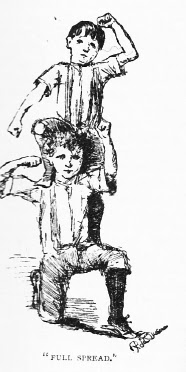
The first exercise that young boys learn is “shoulder and legs,” which is practiced assiduously till performed with ease and rapidity. After this comes “splits.” This exercise looks as if it ought to be not only uncomfortable but painful; but a strong proof that it is neither was afforded me involuntarily by one of the little boys. He did it repeatedly for his own benefit when off duty! After this the boy learns “flip flap,” “full spread,” and a number of intricate gymnastics with which the public is familiar. In all these performances boys are very much in request, partly because they are more popular with the public, and partly because in a variety of these gymnastic exhibitions men are disqualified from taking any part in them owing to their weight. In the figure technically known as “full spread” (shown in illustration) it is essential that the topmost boy shall be slightly made and light in weight; but even under these conditions the strain on the principal “supporter” is enormous. As regards danger, so far as I have been able to learn from a good deal of testimony on the point, there is very little of any kind. The only really dangerous gymnastic turn is the “somersault,” which may have serious results, unless done with dexterity and delicacy. There is no doubt that exercise of this kind is beneficial to the boys’ health. Several boys in excellent condition, with well-developed muscles and chests assured me they were often in the “’orspital” before they became acrobats.

Their improved physique is possibly in a great measure due to the capital feeding they get, it being obviously to the advantage of the “father” to have a robust, rosy-faced company. Master Harris, of the “Yokohama Troupe,” informed me that he generally has meat twice a day, a bath every evening (gymnasts are compelled by the nature of their work to keep their skins in good condition by frequent bathing), that Mrs. Bale was as kind to him as his own mother, and that he thought performing “jolly.” He further informed me that he got three shillings a week for pocket money, which was put inton the bank for him.

Another boy in the same troupe told me he had over £9 in the bank. Of course, all companies are not so well looked after as the boys in Mr. Bale’s troupe; but I have failed to discover a single case where the boys seemed ill-used. Where the troupe travelled about Europe, the lads were exceptionally intelligent, and several of them could talk fair French of German. A really well-equipped acrobat is nearly always sure of work, and can often obtain as much as £30 a week, the usual payment being from £20 to £25 a week. As a rule, the boys remain with the master who has given them their training, and who finds it worthwhile, when they are grown up, to pay them a good salary. A troupe gets as much as £70 or £80 a day when hired out for fetes or public entertainments. There is one point which will possibly interest the temperance folk, and which I must not forget. The boys have constantly before them moderation in the persons of their elders.

“Directly an acrobat takes to drinking,” said Mr. Bale, impressively, “he is done for. I rarely take a glass of wine. I can’t afford to have my nerves shaky.” Altogether there are worse methods of earning a livelihood than those of the acrobat; and a propos of this point, an instructive little story was told me which sentimental, fussy people would do well to note. There was a certain little lad belonging to a troupe the owner of which had rescued him from the gutter principally out of charity. The boy was slight and delicate-looking, but good feeding and exercise improved him wonderfully, and he was becoming quite a decent specimen of humanity when some silly people cried out about the cruelty of the late hours, and so on, and insisted that he should be at school all day. The lad, who was well fed, washed, and clothed, was handed back to the care of his parents. He now certainly attends school during the day, but he is running about the gutter every evening, barefooted, selling matches till midnight!

On the subject of ballet children there is also a great deal of wasted sentiment. All sorts and descriptions of children are employed in theatres, from the respectable tradesman’s child to the coster’s child in Drury Lane; but the larger proportion are certainly of the very poorest class, and it must be remembered that these children would not be tucked up safely in their little beds, if they were not earning a few badly-wanted shillings; they would be running about he London streets.

Mr. D’Auban – who has turned out a number of our best dancers, such as Sylvia Grey, Letty Lind, and others, - was kind enough to call a rehearsal of his children, who are now performing at the Lyric, Prince of Wales, Drury Lane, and other theatres, so that I was enabled to see a very representative gathering of these useful little breadwinners. Whatever else may be urged against the employment of children in theatres, there is not the least doubt that dancing is a pure pleasure to them. Out of all the little girls I questioned, not a single one would admit that she ever felt “tired.” A good many of the children belong to theatrical families, and have been on the stage since they were babies; they were distinguished by a calmness and self-possession which the other little ones lacked; but in the matter of dancing there was very little difference, and it was difficult to believe that a large proportion of the children now playing in “La Cigale,” knew nothing about dancing six months ago. Mr. D’Auban has no apprentices, no agreements, and no charges, and he says he can make any child of fair intelligence a good dancer in six months.

The classes begin in May, and, as soon as it is known that Mr. D’Auban wants children, he is besieged by parents with little maids of all sizes. The School Board only allows them to attend two days a week; but Mr. D’Auban says: “Everything I teach them once is practiced at home and brought back perfect to me.” The children wear their ordinary dress, and practicing shoes of any kind are allowed. First the positions are mastered, then chasses, pirouettes, and all the rest of the rhythmic and delicate movements of which ballets consist.

Many of these graceful little dancers are the real bread winners of the family. Little Minnie Burley, whose charming dance in “The Rose and the Ring” will be remembered, though only eleven years old, has for more than a year practically supported herself and her mother by her earnings. The mother suffers from an incurable spinal complaint, and, beyond a little help which she gets from another daughter who is in service, has nothing to live upon but the little one’s earnings. During the double performance of the “Rose and the Ring,” Minnie earned £1 5s. a week; now she is earning as a Maypole dancer in “Maid Marian” 12s. a week: but her engagement will soon end, and the poor little maiden, who has the sense and foresight of a woman of thirty, is getting rather anxious.

She is a serious-faced, dark-eyed child, very sensible, very self-possessed, and passionately fond of dancing. Her mother is devoted to her, and keeps her exquisitely neat. I asked her whether she did not feel a little nervous about the child coming home alone every night from the Strand.
“No,” said Mrs. Burley, “you see, she comes by ‘bus, and she knows how to take care of herself – she knows she is not to let anyone talk to her.”

Minnie is a type of dozens of other hard working, modest little girls who are supporting themselves, and very often their families, by dancing. As a rule, the mothers fetch the children, or make arrangements for several to come home together. Many of them, whose husbands have been out of work, or who are widows, or deserted, have assured me they could not possibly have got through the winter without the children’s earnings, whilst the children themselves are immensely proud of “helping” mother. The pride they take in their parts is also very amusing. One small girl ran after me the whole length of a street. She reached me breathless, saying, “Don’t forget I’m principal butterfly.” Another small mite gave me a most crushing reply. She made some allusion to her mother, and I said innocently, “I suppose your mother is a dresser?” She looked daggers at me, and said indignantly, “My mother’s a lady wots in the ballet.”

The wages of the children range from 6s. to 16s. a week, and, as their engagements often last for four months at a time, it will be seen that their money is a valuable, and in may instances an essential, addition to the mother’s purse.
Child models, being required almost exclusively in the daytime, are, thanks to the vigilance of the School Board authorities, becoming more and more scarce. The larger number of them comes from “model families,” the mother having sat herself, and having from an early age accustomed their children to “sitting.” The children of these families have no difficulty in obtaining regular work; they get a reputation in the painting world, and one artist recommends them to another. In the neighbourhood of Fitzroy Square, Holland Park, and St. John’s Wood these families abound, and are mostly in respectable circumstances. A pretty little girl, whose mother is a well-known model, and who has herself figured in several of Millais’ pictures, told me with condescension that she had so many engagements she didn’t know which artist to go to first.

Mary M–––, whose face is familiar to admirers of Miss Kate Greenaway’s pictures, is, except for a couple of months in the summer, never out of work. She is a beautiful child of fourteen, the daughter of a cab-driver, who is not always in regular employment; and, as Mary has a tribe of little brothers, her earnings are of the utmost usefulness. For several months she has been sitting to three artists, and making the very respectable sum of £1. 10s. a week.
In her spare moments Mary takes music lessons, and her great ambition is to become an illustrator in black and white. All her earnings are cheerfully handed over to her mother, who is careful of her little daughter’s welfare as can be.
“I don’t sit as a nude model,” Mary said, “but only for my head, and mother doesn’t let me go into any studio.”

As a matter of fact, children are not used as nude models to any great extent; they do not sit still enough, and their limbs are too thin and unformed to be of much use. Besides the regular professional models, who get 5s. a day, and are pretty sure of engagements, except in the summer, there is a fairly large class of street children who call at the different artists’ studios, and are taken on occasionally.
“I get any number,” said a well-known artist. “They come down to me, and are kind enough to suggest ideas. One small girl said to me the other day. ‘could you do me in a blue dress, sir; mother says it would go well with my golden ‘air.’”

Many artists prefer these children to the regular model, who get a stereotyped expression and artificial poses from long habit. Mr. T.B. Kennington, whose pictures of poor London children are familiar to the public, told me that he always actually paints from the class of children that he depicts on his canvas. The boy whop figured in that painful and powerful picture of his, “Widowed and Fatherless,” is a real little London waif.

"Widowed and Fatherless" T.B. Kennington, 1888
 His mother is said to have been pitched out of window by her husband, and the boy, whose sad face arrests the attention of the most careless observer, lives with his grandmother, who does washing.
“Do you make the children ‘put on’ this sad expression?” I asked Mr. Kennington.
“No, indeed; my great difficulty is to make them smile, except momentarily. Haven’t you ever noticed how melancholy children look in repose?”
This may be true about children who are constantly half-starved and ill-treated, but surely it is not true of children in general, or even of the majority of children of the lower classes, who contrive to wear an air of marvelous brightness, in spite of cold, hunger, and even blows. “Sitting” does not seem to be an occupation that commends itself to children, who naturally dislike keeping perfectly still in one position. Nearly all the little models prefer ladies, who keep them quiet by telling them stories, and bestowing sweets and cakes on them; whereas male painters have less persuasive methods of making them do what they want. These latter, however, make many attempts to reform the manners and morals of their small models, many of whom, they say, evince an appalling amount of depravity.

Mr. F.W. Lawson, who painted some veritable little slum waifs, in his series of pictures called “Children of the Great Cities,” told a good little story of one of his attempts in this direction. His model was a small, bright-faced, black-eyed street boy.
“Well, Fred, what have you been doing today?” asks Mr. Lawson.
“Playing on Battersea Bridge, sir, and chucking stones at mad old Jimmy,” was the reply of the urchin, who then proceeded with much gusto to describe the details of this sport.
Mr. Lawson, on learning that mad old Jimmy added blindness to his other infirmities, spoke strongly about the cruelty and cowardice of such an entertainment; and ended up by telling a story of a heroic deed by a blind man.
“When I looked up,” said Mr. Lawson, “I saw the boys eyes were full of tears, and I thought to improve the occasion by asking, ‘And now, Freddy, what will you do if you meet mad old Jimmy again?’ The little scamp looked up with a wink and said, chuckling, ‘Chuck stones at ‘im, sir.’”

Professional models, especially those who have sat to eminent artists, have an exaggerated idea of their comeliness, and they will draw your attention to their good points with much frankness.
“I’ve got beautiful ‘air.” Said one little girl, modestly pointing to her curly, chestnut locks; whilst a small boy, usually called the “Saint,” from having figured in several religious pictures, requested me to observe his “fine froat,” as if he had been a prize beast.

In London, owing to the numerous restrictions imposed on employers, there are only a comparatively small number of children working in factories. Girls of thirteen and upward are employed in confectionary, collar, jam, and match and other factories where skilled labour is not required, whilst small boys are principally found at rope works, foundries, and paper-mills, where their chief business is to attend to the machinery. It is almost impossible to mistake the factory-girl, and even at a glance one notes certain characteristics which distinguish her from her sister workers. Contrast her, for instance, with the theatre child out of Drury Lane. The little actress may be as poor as the Mile End factory girl, but in nine cases out of ten she will be neatly clad, with spotless petticoats and well-made boots and stockings. If you watch her, you will notice she walks gracefully, and instinctively assumes, whenever she can, a picturesque and taking attitude.
The little factory girl is decently enough attired so far as her frock is concerned, but she, or her mother, cares nothing about her boots, which are invariably cheap and untidy, whilst any superfluous coin is devoted to the adornment of her hat, an article of great importance amongst factory-girls – young as well as old. But a still more characteristic feature, which, so far as I know, is peculiar to factory-girls, is their curious method of walking, which is carefully cultivated and imitated by the young ones. It is a sort of side “swing” of the skirts, and has one of the ugliest effects that can be produced, especially when executed by half a dozen young ladies walking abreast on the pavement.

At Messrs. Allen’s chocolate and sweet factories, in Mile End, some two hundred women and girls are employed. Referring to the strike, I asked a highly respectable, intelligent-looking girl, why she joined it:
“Well, I don’t hardly know,” was the candid reply. “It was all done in a rush, and the other girls asked me to come out.”
This girl was earning, by the bye, 17s. a week.

The quite young girls are principally employed in packing chocolate into boxes, covering it with silver paper, which operation they perform with great dexterity, labeling, and other easy work of this nature. The rooms are large and well ventilated, and each department is under the care of a forewoman, who not only keeps a sharp look-out on the work, but exercises what control she can have over behaviour and conversation.

The discipline did not strike me as particularly severe, considering that the girls left their work en masse, as soon as one of their number had announced, referring to the artist, “She’s takin’ Em’ly’s likeness.”
The hours, from 8 to 7, are certainly too long for girls in delicate health; but the work itself is light, and a capital dining-room is provided on the premises, where the girls can cook their dinners and make themselves tea. Nor are the prospects at all bad. Here is Alice C –––, a girl of fourteen, the daughter of a flower carman, not always in work. She is a packer, and gets 6s. a week, which she hands over to her mother. She says she likes doing things with her hands, and would not like to be in service, as then she wouldn’t have her Sundays to herself. If she stays on at Messrs. Allen’s, her wages will be steadily raised to 18s. a week; and, if she ultimately becomes a piece-worker, she may make as much as 24s. or 25s. a week.
Considering that a good many educated women are teaching in High Schools for salaries of £65 per annum, this is surely not bad.

Of course all factories are not as well managed as these chocolate works, and where the hardship comes in is where hands are turned off at certain periods of the year, or when the work itself, like match-making, is injurious to health.

Still more unfortunate is the lot of some of the little girl workers who assist their mothers at home in tailoring, button-holing, and dolls-clothes making. The united work of mother and child yields only a wretched pittance, and, carried on as it is in a room where sleeping, eating, and living goes on, is, of all forms of labour, the saddest and most unhealthy. Meals consist of bread and tea, and work is prolonged till midnight by the light of one candle, with the consequence that the children are prematurely aged and diseased. This is the most painful kind of child-labour that I have come across, and would be unbearable, if it were not ennobled by the touching affection that almost invariably exists between the worn-out mother and her old-woman-wise little daughter.

The lot of the child-vender in the streets would be almost as hard, if it were not, at any rate, healthier. Terrible as are the extremes of weather to which the little flower-girl or newspaper boy is exposed, the life is in the open air, and a hundred times preferable, even if it results in death from exposure, to existence in a foul-smelling garret where consumption works its deadly way slowly. Children find an endless variety of ways of earning a living in the streets. There are the boot-black boys, who form a useful portion of the community; newspaper boys, of whom the better sort are useful little capitalists, with an immense fund of intelligence and commercial instinct; “job chaps,” who hang about railway stations on the chance of earning a few pence in carrying bags; flower-girls, match-girls, crossing sweepers, who can make a fair living, if they are industrious; and lastly, although this enumeration by no means exhausts the list – street prodigies, such as pavement painters and musicians. All Londoners must be familiar with the figure of little Master Sorine, who sits perched upon a high stool diligently painting away at a marine-scape in highly coloured chalks.

This clever little artist of eleven is the principal support of his parents, who do a little in the waste-paper line when there is anything to be done. As a rule, Master Sorine is finishing his marine picture or landscape when I pass by, so that I have not had an opportunity of judging of his real ability; but his mother, who keeps guard over him, assures me that he can draw “anything he has seen” – an assertion which I shall one day test. The little fellow is kept warm by a pan of hot charcoal under his seat, which would seem to suggest rather an unequal distribution of heat. However, he seems to think it is “all right.”

His artistic efforts are so much appreciated by the multitude that on a “good day” he earns no less than 9s. or 10s., which mounts up to a respectable income, as he “draws in public” three days a week. Master Sorine, however, is exceptionally fortunate, and indeed, there is something particularly taking about his little stool, and his little cap, and the business-like air with which he pursues his art studies. Nothing can be said in praise of such “loafing” forms of earning a livelihood as flower-selling, when the unhappy little vender has nothing but a few dead flowers to cover her begging; or of “sweeping,” when the “crossing” of the young gentleman of the broom is often dirtier than the surrounding country.

Now and again one comes across industrious, prosperous sweepers, who evince a remarkable amount of acuteness and intelligence. It may have been chance, but each of the crossing sweepers I questioned were “unattached,” disdained anything in the way of families, and declined to name their residence on the ground that they were “jes’ thinkin’ o’ movin’.” This is a very precarious method of earning a livelihood, and is generally supplemented by running errands and hopping in summer.
In a wealthy neighbourhood, frequented by several members of Parliament, who were regular customers, a very diligent young sweeper told me he made on average in winter 2s. 6d. a week; but he added contemptuously:
“Business ain’t what it used to be. Neighbour’ood’s goin’ down, depend on it. I’m thinkin’ of turnin’ it up.”
This young gentleman supplemented his income by successful racing speculations, obtaining his information about “tips” from his good-natured clients. It seems sad to think how much good material is lost in these smart street boys, whose ability and intelligence could surely be turned to better account. The most satisfactory point – and one which no unprejudiced person can fail to recognize – in connection with the subject of child-labour is that healthy children do not feel it a hardship to work, and that, therefore, considering, in addition, how materially their earnings add to their own comfort, all legislation in the direction of restriction and prohibition ought to be very carefully considered.

I must express my best thanks to Mr. Redgrave, of the Home Office, for his help in obtaining entrance to factories, and to Mr. Didcott, the well-known theatrical agent, for his kind services in the matter of acrobats.
             - Strand Magazine, 1891

The Strand Magazine ran for almost sixty years, before ceasing to be in 1950, however, it was brought back into publication in 1998, and has a website; strandmag.com

Anyone interested in articles of this ilk, or lesser-known works of fiction by popular authors of the past would be well-advised to look on eBay, or search antique book shops for bound editions of this magazine, as they really do contain some interesting work.

Returning to the subject of Victorian children before I close, to offer a little contrast I may return to The Strand for another article on Victorian children in the near future, but on a somewhat brighter note.

Finally, in closing, a picture of the modern-day Strand!